Adolesence Solstice

Catherine Buchanan

I wandered out of childhood’s snow dusk streetlights,

Buffalo solo, trying to get lost, looking for some time

some place to escape into.

 Was anything they told us actual?

Was life just a list of tasks and tests?

 Was I just a dart in someone’s game?

Are our truths only what we distained unlearning?

                                       *

Serial lives lived  in the same body, our names

should change as we age, reflecting our progress,

revealing our fuck-ups, the places we had to flee.

The police may have persons of interest,

the church its assertions & predrawn conclusions.

You and I have only our suspicions, a sense of

where the edge should be, where the end begins.

Dragnet stockings

*

Arrested for raping a robot

he hired the hottest chatbot attorney.

*

That old story, the fine print of life

consent the solitary issue.

Who schedules your weather?  

Did anyone ask for your absentee vote?

*

Isn’t it complex enough already?

The robot had a faithful android dog

infested with transistor fleas & a

venomous bite, who recorded it all.

*

A hung jury.

Peace

*

Just after five, the sun has been down almost an hour.  It did not warm above freezing

today. The delivered supermarket lilies start to open. I guess I could invent some other,

earlier TGIF to occupy.  Maybe not—nostalgia as useful as a vagrant’s zip code tattoo.

*

I associate places with things that fly—this coast gulls, California willets and sandpipers,

Hudson Valley bald eagles, Pago Pago fruit bats and airborne coconut beetles.  Here in

the village the air space has been empty all day, and everything murmurs pointlessness.

*

Despair is the church’s ultimate sin.  It’s also crazy, like getting pissed off at fresh dusk

or celebrating what our senses censor—that sound of wings in the sudden darkness.

History = Leftover time


         She had to know we would discover that her forced confession was a web of lies.  Her addiction to invention, fiction as reality.  Her pubic hair and head hair were different colors.  Her secret was that none of it mattered.  Only her name was real because that mattered least.  Her name never changed.

Yes—Lucas went back to the tapes and checked—she never failed to supply weather details, for veracity’s sake.  You always knew the season.  She could recite who had been present as if reading a photograph.  One of the guards got a thing for her, like a keeper at a predator zoo.  They would share meals, pretend they were from the same hometown.  After she vanished, he never came back to work.  There was nothing to guard then anyway. 

If you erase the past, the space is still there, hand prints on a cave wall.  What’s locked in our snake brainstems are neither memories nor promises.  Just ask her.  She had no idea how attractive she was.  If you find her, ask her.   With her vaporizing past she never seemed to age.  No telling how young she would be now, but there are some clues in these old confessions as to what might be coming down soon.  I don’t have the guts to search for her.  I am pretty sure she won’t remember, but why take the chance?

November

If death had a color it would be this afternoon’s sky

relentless greys, the promise of snow and no escape

the stale taste of an attic shadow.  

                                                               All of my dreams

are free to be silent, even the echoes are empty—no

voices or conversations, no sounds of the mad birds

smashing themselves again and again into the glass.

*

From this height the distances ought to seem closer

but at this age failing eyesight hides what is out there.

There is the light coming through, through the gloom

a light from out there, from outside you, beyond you.

Word Chow

Maybe it was Abbie Hoffman.  It was of that era.  Poets still played pool and you could fix your own car.  The book’s title was Steal This Book.  I guess I could Google it to check the author’s name, but I am pretending it is 60 years ago, pre- the Post-Literate-‘Lectron Era, back in book time.  No temporal cheating. 

I learned today that four of my novels had been swallowed whole by some Cyclops of an AI Large Language Model, off somewhere washing them down with gigavolt gulps of wasted energy.  I envision chewing.  Eat This Book.  I am not surprised that it does not bother me.  Only cadaver pieces are worth anything.  All those words were not mine once they left the house, freed.

I am invited to litigate.  I forget there are people who do this for money.  Let them sue, and good fortune.  But how can you have freedom at all unless some things are free? 

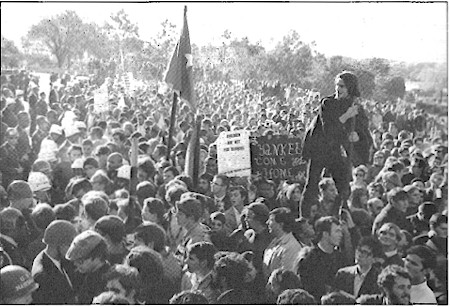
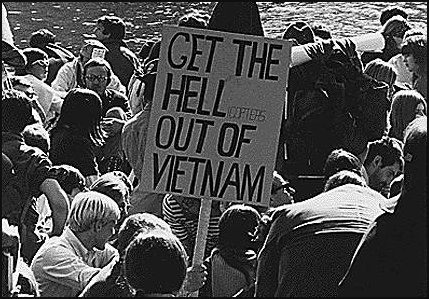
21 October 1967 / The Pentagon

I suppose you could call it a smock—a shapeless jacket of cheap grey fabric.  We wore them to shield our clothes from printers ink.  We were the clippers in Newsweek’s reference library/morgue who spent much of our workday reading newspapers, searching out and clipping articles to feed the needs of staff writers.  In 1967 there was no “on line.”  What news there was was in print or on the evening network news.  The country relied on newspaper reporters to reveal what was happening, and every major city had competing presses. 

I was a master of trivia in those days, a current affairs expert, and probably a drag to be around.  The Newsweek building was on Madison Avenue.  I wore my one suit and a tie every day for minimum Newspaper Guild wages.  Beside my desk was an industrial-size trash barrel that would be full of perused newspapers by the end of the day.  It seemed like everyone smoked.  Amazing there were no fires.  There were no women.

I was going full-time to night school at City College, up on the edge of Harlem.  There was this thing called the draft back then.  As long as I stayed matriculated fulltime I was eligible for a student deferment, which would keep me out of Southeast Asia jungles, or Canada, or jail.  Wearing a suit and tie was a small price to pay for the freedom from being treated like disposable dirt.  Night school at CCNY in the late ’60s is another story.  The civil rights strikes, campus lock-ins, and police stand-offs.  Harlem streets on the night Martin Luther King Jr. was shot.

If you were alive then and there, you were on a side.  I was with the protesters—a peacenik,, sit-in sitter, protest sign painter—in an unfortunately humor-deprived world split along a largely generational divide.  The old folks had dismissed us, and we welcomed that.  I advised draft dodgers.  For a while my father banned me from his house.  My oldest brother, a National Guard vet, picked a fight.  When plans emerged for a united national anti-war demonstration in Washington, I got involved in organizing a New York City contingent. 

We called our collected goals and actions the Movement, and this was before tectonic plates were discovered.  If you were part of the Movement, you were wary of leaders.  It was popular to claim that we all were in charge and that decisions were made by consensus.  So, there were was no leader in the busload of amateur rebels we put together from the Lower East Side.  The Peace Parade Committee paid for the rundown bus, and I got an address in ghetto D.C. where some of us could crash while there. 

At Newsweek I went to my boss and told him I would be taking that Monday off.  When he asked why, I told him I would be coming back from the weekend rally in D.C.  When his reaction was neither approval nor disapproval, I proposed filing an observer’s report, background for whatever story the nation desk might choose to run on the event.  He was a preternaturally skeptical  man.  I was not a reporter.  I was a clipper.  He said he would get back to me.  It didn’t matter one way or the other.  I was surprised when he came through.  File my report, he told me.  He would count it as Monday’s work.  He couldn’t get me a press pass, but he gave me an official-looking nametag that identified me as a Newsweek employee. 

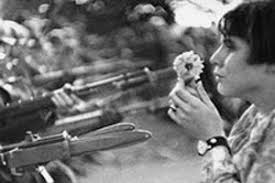
There is no copy of what I filed.  I spent Monday night typing up good copy and handed it in Tuesday ahead of deadline.  Xerox was not a ready option sixty years ago.  There are other versions of that chaotic, sometimes sickly brutal weekend.  Mailer won awards for his.  I watched federal marshals in cheap baggy suits enjoying their pummeling bloody young women sitting cross legged in front of me before dragging them off.  Behind us was a line of soldiers with fixed bayonets.  I really had to take a piss and, showing my Newsweek ID, I persuaded a nervous young officer to let me escape through their lines.  It was not a moment to be proud of.

When advance copies of a week’s issue arrived at Newsweek all other work would stop to behold the object of our labors.  What hath been made of them?  The Pentagon did not make the cover.  Instead there was a long-planned hit piece—“Trouble in Hippieland”—about what was being called the “counterculture.”   A pearl-clutcher’s truffle on the evil-filled underworld of drugs, free love, and squalid poverty to which suburban kids were fleeing, it focused on two gruesome murders in the East Village. 

The march on the Pentagon headed up national coverage—a sympatico segue.   An anti-war protest was a warning that the counterculture malaise was dangerously festering.  In Newsweek’s coverage, the march and protest were nothingmore than a riot and the participants traitors.  The official crowd estimates of 100,000 in the march and 50,000 at the Pentagon sit-in were not mentioned, but the number of arrests, 648, was given and a wild guess was made at the tons of garbage left behind.  All government press release stuff, not a word of the Movement’s goals or the march’s purpose.  The photos were all UPI or AP.  I wondered if Newsweek had any reporters there at all.  There was nothing from my report. 

In my twenties I wasn’t much into premeditation.  I know what I did next that day required no advance consideration.  I stood up, tore my copy of the magazine in half, and tossed it into my refuse barrel.  Then I took off that fucking grey smock and threw that in there, too.  My co-clippers watched in silence as I left.  I had no phone in my one-room place on East 3rd Street, so I never heard back from Newsweek.
on turning 80 for Mika

80

Two-rut road headed for a rise

where the ruts converge in a vanishing point.

We both been there.

                                     I sent you a postcard.

You sent me a poem.  There were buzzards.

Years passed, back country, no big deal.

Your black and white ‘56 Chevy burned oil.

We had sons who never met

and wives who left us, haiku and manifestos.

Instructions have again arrived—

we follow this trace to vanishing.

Solstice Feast Days

The empty tin can old man trash

the barren sad refrigerator,

a weakness in the verbs & an

all-too-easy fondness for escape.

*

It’s time to match the bird calls

to the memory of the birds.  It’s

hard to believe you once thought

any of it mattered, hid meaning,

*

among all the things you can no

longer swallow   Beer caps rolling

out of sight and into the past—her

name erased along with all the gods.

Seeing / Believing

Catherine Buchanan

Now that I know she is lip-syncing

I can’t watch her,  I can only listen.

The ballet dancer with broken toes

keeps returning to my dreams and I

try to forget all the card tricks I know,

*

Play it again, Sam.  Lay it all out.

The invented genealogies and fake IDs,

your talking parrots and loaded dice.

We live to be fooled, to escape what

we know, to go with whatever works.

*

I could watch her walk all day.  She

wouldn’t have to sing or speak a word.