Hong Kong / Vows / 1976

Hong KongI gave it all away, all the cash I had on me down to my least coin. It was like feeding chickens. That back street in Kowloon was famous for its beggars, and once I started handing out cash it didn’t take long. Pierre Cardin suit, Italian shoes, silk tie, a foot taller than all the poor dudes that crowded around me. In my coat pocket was my final purchase—a pint of Wild Turkey. I remember it was a chilly night, December. Of course, I had a hotel room to go back to, and the next day I could go to the bank and get more cash, but I was celebrating my freedom by giving away my chains.

Seventy-six was a tough year, my thirtieth—burn out and break down at my editor’s job in Berkeley, a state of imploding confusion in my so-called love life, shrinks and drugs and a growing fear of others. There was the odd but deeply felt conviction that I didn’t want a future, but I had zero attraction to thoughts of suicide. I didn’t want to perform; I just wanted to wander and watch. It had taken me less than a month to get sacked from my Hong Kong editing job.

A couple of nights before that night in Kowloon I had done a Kiwi bloke I had met the favor of taking him to a respectable whorehouse. He was headed off to an Arctic oil rig for six months and wanted a weekend of companionship to send him off. I knew where to take him from wandering and watching, not from performing. The American Nam thing was winding down, and there were a lot of under-employed prostitutes in Hong Kong now that the Yanks were no longer coming there for R and R. He picked his girl out of the second group the Mamasan sent over to our booth. He seemed happy and I got up to leave. Only Mamasan wouldn’t let me. She and a line of her girls blocked the door. What about me? Her girls weren’t good enough for me? By now some of the girls were cursing me in Cantonese and others were crying and running away. Mamasan picked up a bottle and waved me away from the door. The Kiwi bloke was laughing, but it wasn’t funny. Mamasan yelled something toward the back of the room, and the most attractive, princess-petite girl we had yet seen, dressed in a slit green silk kimono, stepped through a bead curtain. I would take her, Mamasan insisted. But I’m a priest, I told her. Ha, she said, priests like it more than most. Mamasan walked over to take the shy girl by the arm and bring her to me. I bolted for the exit, shouldering aside the girls who tried to stop me. They clawed at my back as I got the door open and hit the street running. Those words, but I’m a priest—that lie—stuck with me. Why not undo the lie and become a priest?

There are three vows—poverty, chastity, and obedience. You can’t grow up Irish Catholic without knowing that. I had a brother who was a priest. So, I decided to start with the first vow, poverty, and gave away all my cash. But that was just symbolic. I had decided that what a vow meant was to disavow all interest in what the vow forbade. Henceforward, money would be a null set. If I had some, fine; if I didn’t, fine. Its accumulation would no longer be of any interest to me, no longer any sort of index of success or failure. As I gave my cash to the beggars on that cold Kowloon back street, I smiled and said, “Null set, null set,” and they smiled back, nodding, saying “Nur sut, nur sut.” We had a great time.

I moved out to Zhang Zhou then, a tiny island on the outer edge of Hong Kong Territory, where there were no roads or vehicles and a room was cheap, a two hour ferry ride from downtown. A junk with an eternal oil slick trailing from it was anchored in the rock-bound cove outside my window. I considered the other two vows. I knew enough about the history of Christian chastity to know that it wasn’t about fucking but about non-attachment to the non-spiritual. I couldn’t imagine denying my impulse to fuck, but I had non-attachment down cold, as it were. If I couldn’t make a virtue out of that, I might at least employ it as an armoring vow. Obedience was the bigger problem. Thirteen years before the Jesuits had rejected me because of my psychological problems with authority. But I found a way around that one, too. I would pledge my obedience to myself, that inner self I had always fought with. If it said head north, I’d head north. If it said find a place to hide, I’d find a hideout. If it told me all this is wrong, I’d drop it and leave. One morning the junk and its oil slick were gone.

I tried to live that way the next five years, on the road a lot. For a while a few people worried about me, but they got tired of that and left me alone. I didn’t make much money, but I didn’t starve. All in all I don’t think vows are a very good idea—that authority thing again. After a while I was happiest when I forgot them and just got on with what I was doing, though I was still broke.
Heisenberg und Heimatlos

Heisenberg

Werner Heisenberg

Yeah, and sometimes reality salad sucks. Yesterday the landlord stopped by to tell us our time here is up. It’s been almost eight years, but the family needs the cabin back, the next generation asserting its priority. Time for the gypsies to move on along. That’s life for a renter, and I have never been anything but. The biggest thing I have ever owned was a pickup truck. I don’t get to use words like equity or liquidity. It’s cleaning deposit and last-month’s rent.

I have no idea where we will go. We can’t afford much locally. Again we are faced with the imminent uncertainty of being homeless. This was more entertaining forty years ago, when uncertainty still held some sense of adventure. And at our age—freshman septuagenarians—there is a certain moral stain attached to not having our fiscal and domicile acts together, surrounded as we are by peers safely cushioned by their savings and entitlements and homes.

Werner Heisenberg is, of course, best known for his uncertainty principle, first introduced in 1927, which in its simplest version states that the more precisely the position of some particle is determined, the less precisely its momentum can be predicted. The metaphoric existential applications beyond quantum mechanics are enlightening and reassuring. Uncertainty is a given. You can’t predict where you will be from where you are now. For all living entities the sole certainty is death. If you are a renter don’t go feeling secure. Shit happens.

Olson’s line: The only thing that does not change / is the will to change.

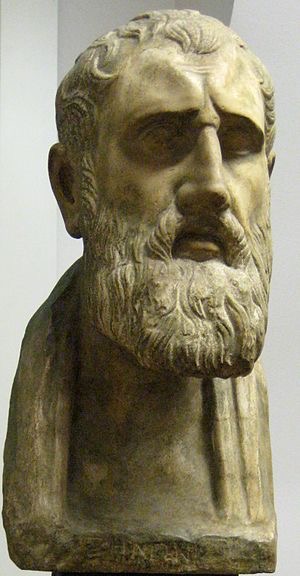
Zeno of Citium

Zeno(letter to Michael Joyce)

Mika:

It is popular and easy to pick on the American male psyche, its blind spots and delusions (e.g., TV ads). We all know who we are and to what extent we replicate the typification. (Robin Williams to Nathan Lane: “I didn’t know John Wayne walked that way.”) It’s a camouflage we all learn young, and some of it grafts into personal armor. Fate knows that we have all escaped bad situations by pretending to be brave and have acted the total dolt in matters hormonal. But tonight I would like to signal out one trait of that cowboy outfit for acknowledgement–Stoicism, no matter how tepidly preserved.
Ranger Zeno of Citium, please step forward; yes, you there, the one not paying attention.

Veterans won’t talk about their wounds. Baseball players cannot rub the spot where it got ’em. Hockey players aren’t allowed to cry. I can get by with, I got out of the hospital Friday. We’ll see what the bill will be. Gotta love it. Home, convalescing, a basketfull of pills to take. No big deal. At the end of how many half-hour shows was Hopalong “just winged,” with his arm in a casual sling as he rode away into the credits? A couple of slugs of saloon rotgut were all the Duke needed before going under the dirty doctor’s knife. “No pain, no gain” bullshit.

I have been in pain as long as I can remember. Pain has been a constant companion, and mostly a secret stalker. It was just another thing to hide. I don’t want to go there tonight, to examining life as a list of what I’ve had to hide. (Although, that is an interesting idea.) I’m just glad I don’t have to talk about it. Besides, I’d misspell a bunch of the med terms and drug names, and, really, who cares? It’s no autopsy.

Of course, a true stoic would also be given to showing no interest in joy as well as in pain. Did they see the difference and manage to treat them the same? Or was it just an emotive control thing? They were all Mediterraneans, after all.  It was no joke in my Irish family that emotions were things that other people had, like Italians. (So I married one.)  But I like our customized American version of masculine stoic, where good shit can be acknowledged but not featured. Pass out the cigars; no need for the obstetric details.

I have again escaped the tubes and needles, and it is Act One of Another Spring. We’ve rehearsed this ten thousand forests before–the dead gray dirt rises up and covers itself then everything else in a verdant blanket of dense, frantic reproduction. Mind-boggling every time.

The stoic accepts what is. The sage is the one with the fewest illusions. I am dying. But I am going to take my fucking time about it. So may we all.

Ioane

Baseball

Satchel Paige

Satchel Paige

It is that blessed time of year again, when the season opens in uncertainty and hope. When new guys blaze across the outfield, slamming into fences, and superannuated sluggers acquiesce to the role of designated hitter. Five months ahead of games behind and on base percentage. A pleasure except for all those goddamn truck ads.

I played a lot of baseball. When I was a kid it defined the months when there was no snow on the ground. I was good at it, but never big enough or strong enough to be more than just good. I was a catcher mostly, and what I liked about the game was that even if you weren’t the best you could often out-think them. I made it to semi-pro in the summer of my seventeenth year, catching for Hewitt-Robbins in the Greater Buffalo Industrial League. They paid me when we won. Then I discovered other things, like girls and the private joys of wandering. When I was a kid I measured the worth of things in catcher’s mitts. Top of the line was about twenty-five bucks, four to a hundred, forty to a thousand. The day my dad sprung for a pair of pricey (one catcher’s mitt) kangaroo-skin spikes I knew he truly loved me. I had a good arm but had trouble hitting the slippery shit that the old guys threw.


Easter, Passover, Opening Day
________________

Another thing I like about baseball
is that they don’t give anyone
whistles to blow or buzzers to
set off or only so many time outs.
As my wife says, it’s real time
and therefore gets to set its own pace.
I describe to her how
your hands sting in early April
when it’s forty degrees out and you
foul off an inside fastball.

What’s so cruel about spring
is that it’s not yet summer,
dusk comes too soon, and everything
must start again in mud and hope.


The Throw to Second
_____________________

If your body can’t—if blind you can’t—
make that throw to second in your dreams
you got no business catching.
The mitt goes down and out
like the weight on a catapult and
from behind your right ear the ball is launched
with a peculiar straight-arm snap of the wrist.
It’s a throw unlike any other,
a bazooka’s accuracy or nothing.
Explosion has no grace. You end up
on your face or close to it.
The shortstop’s safe because
the throw was there in time
to cancel the slider’s need for spikes
and you’ve nailed the sucker.


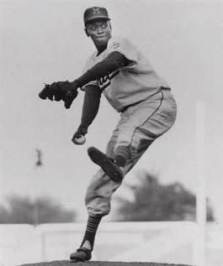
Leroy Satchel Paige
__________________

The soul of any journey
is its unendedness,
therefore all our heroes
should be those who just
refused to fucking stop.

Like someone who at 42
began his “rookie” season
in the show with Cleveland
some thousand wins behind him
in the Negro Leagues, the bush

which counted for zip in
the real books, the white books
the history of the bigs.
Like some unpublished Homer
some hero of an unknown kingdom

an ageless sage playing baseball
in a shadow world of greatness
ever moving—Mobile to
Chattanooga, Pittsburgh to
K.C., Cleveland to the Cards.

At 59 he was still throwing
shutout innings for the A’s.
Excuse me if I stare
trying to see who’s pitching there
extra innings after midnight.


The Zen of Baseball

Satchel Paige didn’t throw fastballs
or curve balls or sliders. He threw
what he called the trouble ball
along with the bat dodger and bee-ball.
He called it the bee-ball because
“it be right where I want it to be.”

He was a skinny dude and I bet
he hid the ball well and worked fast.
I would have liked to catch for him.
Somehow I would know where he wanted
the target of my mitt to be
—bat dodger down and away.

The Zen part is we wouldn’t keep score,
no stats, just the next swing and miss.

(Poems from 14 Degrees South, University of the South Pacific Press, © John Enright, 2012)

Tough Guys

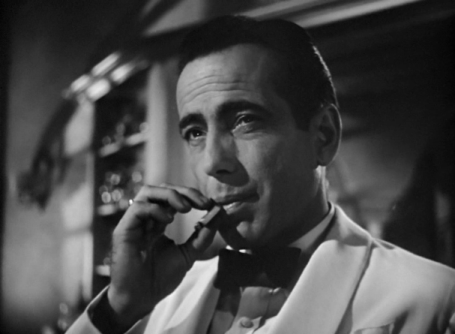
Humphrey Bogary “He looked at me as if I was a cigarette stub, or an empty chair. Just something in his line of vision, without interest for him.” (R. Chandler, The Long Goodbye)

Immersing myself in old-shelf Hammett, Chandler, and Cain, their folk art, indulging the Bogart in me. At the local public Jamestown Philomenian Library (no one knows what that middle word is supposed to mean) the separate shelf space for mysteries is almost as large as the shelf space for all the rest of adult fiction. I wonder why I stayed away from it so long. There are even large-print editions of some of the classics, for us old folks, who remember the original editions.

Sure, the plots are familiar, but the plots aren’t really what the stories are about. They are all about self-knowledge—not deep self-knowledge, just a sure awareness of what’s coming down and how ego—the personal third-person, hardly omniscient narrator—will react to it. The goal of each story is our man not having to alter or even seriously question—much less apologize for—his sense of himself. The ones that get roughed up are the best at this.

You got to like these guys. Shamus surely should be a cognate of shaman. Anchorites on the edge, approached only for their special knowledge and extra-societal competence. The rules are made to be broken. I glimpse features of Amerindian trickster heroes here—coyote unbound by politesse—and the Wild West tall-tale. An American hero, someone your wife would never invite twice for dinner. That dangerous friend.

The only way to solve a mystery is to become caught up in it. And, of course, the babes are always young and comely, decked out in bespoke Hollywood innocence, but always with their own agendas. Lashed to the mast of his low-life craft, our man is tempted but does not yield. Babes are nothing but trouble. The streets are noir. There is no gore. The dialogue is repartee.

Like the words on the page, it’s a black and white world, but with shades of gray in the best. Those are a sort of history, snapshot albums of an American time when men wore fedoras and cars had running boards. Chandler’s Los Angeles and Hammett’s San Francisco are more real than what is there today. The Greatest Generation Tom Brokaw called them, the tough guys. Once they were role models, cigarettes and all.

Our Fear Of Food

Eating raw

Eating Raw (Photo: L. Ellis)

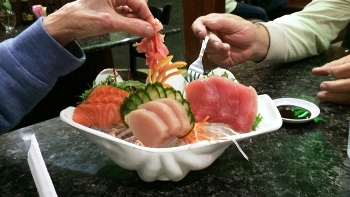
Along with all the other things that today’s Americans have been trained to fear—Arabs, microbes, liberals, aging, immigrants, erectile dysfunction—is food. Food prejudice has become so common place as a personality trait that there is a full Internet smorgasbord of groups you can choose from to join of like-thinking devotees to your particular anti-taste.

Certainly, food taboos are as old as indigestion. Leviticus raised diet no-nos to an alchemical art form, with abominations based on abstract theories of the pure and the impure. Why is it again I can’t eat rock badger? (Did Leviticus suffer from a gastro-intestinal complaint? We know that Martin Luther was tortured by constipation.) Sure, lots of it made sense—Uncle Fred ate that and died. Every species figures out what it can and cannot eat. Nothing mystical or even mysterious about that. But the secret to our species’ frightening success is its rare and wondrous feat of being omnivorous. We even learned how to leach and cook the bad stuff out of poisonous food.

One of the revelations that remains with me from Stephen E. Ambrose’s wonderful saga of the Lewis & Clark Expedition Undaunted Courage is the description of what the expedition members ate on their multi-year trek. For weeks it might be just meat—bear or buffalo or horse or dog—then just foraged roots and berries for a while. Hard tack biscuit and salt beef for a spell? Fine. Those guys would eat (and drink) anything, and none of them died from their diet.

I was certainly raised to eat whatever was put in front of me. Sure, I had my favorites, but I did not pass the turnips without taking some. They weren’t punishment; they were food. Nothing to fear. Put some butter on them. Growing up, I never knew anyone with a food allergy other than lactose intolerance, which was a drag because she couldn’t eat ice cream. Nothing to brag about there. Nobody passed on the peanut brittle. Of course, our diets were limited. Our Irish American mothers never cooked Italian, for instance, which is why pizza places were such a hit when they arrived in our teenage years.

My first introduction to food as something other than just food came in the home of my name-same uncle Dr. John Enright, a family doctor (they weren’t called practioners yet) in Buffalo. I was maybe ten and was there for dinner. Uncle John would borrow me now and then because he had just girls. Reconstructing the scene from facts gleaned later in life, I think Uncle John had discovered the recently available Oesterizer blender and was experimenting on his family’s digestive systems by serving them food that they did not have to chew. On our plates were three mounds of mush—brown (meat), green (veggie), and white (carbs). I ate it, but I thought it was weird. I thought maybe I should be blind-folded as well, then led back to a cell.

Beggars can’t be choosers is among the most blatantly true clichés. And you can be on a socio-economic rung or two above beggar class to personally attest to the fact that the hungry can’t be picky. I do not want to look up the U.N. number of how many millions of children went to bed hungry tonight. (I get up to fix myself a snack of cheese and crackers.) Facts like that stop everything, and I do not want to stop. I want to go on about this fear of food thing. I just wanted to remind us of the reality, of the fact that our parents and their parents and theirs back to our let’s-get-out-of-the-trees ancestors were thankful for their daily gluten, for whatever they could get to eat. And happiness was going to bed with something in your stomach besides empty rumblings.

Fear. What a powerful cultural force fear is. If you can control what people fear, you can control them. Human communities were born because of fear and its perceived countervailing safety in numbers. A savage was once sauvage, just someone who lived outside the walls. The fear of death was used to ritualize and control the lives of our predecessors. Fear—fight or flight—and its resultant pheromones are as basic to our nature and survival as the reproductive imperative and its raging hormones. Only, fears are learned, and they are contagious. There are both rational and irrational fears, but the defining adjective does not alter their efficacy.

We have a word for irrational fears—phobias. The suffix phobic has become as familiar as backward baseball caps in America. As our contextual world has expanded, so has the universe of things to be afraid of. In some ways our phobias have come to define us. I know a woman who will not fly on any airlines with the word west in its name. Another friend, a nice guy but a filthy-lucre germaphobe, will not touch money. Perhaps it is because we are already protected from so many real dangers.

Food phobias constitute a special case, though. If we fear what we eat, and we are what we eat, does that make us fear itself?

Slow Motion

No need to surprise.

I’ve been surprised before

and it doesn’t last.

It’s the slow things now

that make me take notice.

Got something slow to show me?

How snow drifts disappear,

ditch water with nowhere to go?


You hear how catastrophes happen

always in slow-mo—the car

tumbling once then again,

stretching endtime like taffy

—half way to eternity, then

half way again, ad infinitum.

The Storage Story

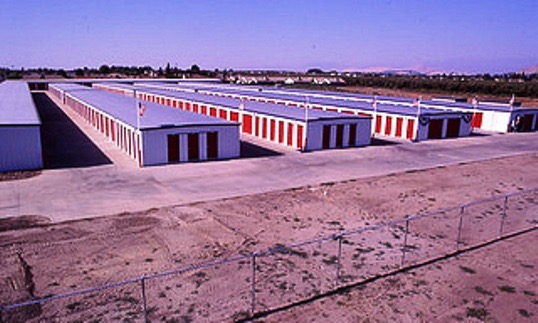
StorageAny meditation on the current state of our nation should include consideration of the recent ubiquity of self-storage facilities. On our recent Eastern Seaboard sojourn I was surprised by the frequency and size of them along the highway. What’s going on? Are we as a nation storing up goods essential to our survival in an imminent Armageddon? Are these ominously boring sites the nuclear age equivalent of our ancestors’ grain silos? Will they save our tribe from starvation and annihilation? Are these the safe-deposit vaults in which the aesthetic prizes of our dominant civilization will be preserved for a kinder prosperity? Or are they evidence of yet another weird twist in the evolution of a society obsessed with the obesity of ownership?

There are now more than 50,000 such warehouses for personal goods across the country, offering Americans close to two-and-a-half billion square feet of rental space in which to stash the shit they can’t fit into their already stuffed houses and garages and backyard storage sheds. In spite of the fact that the size of the average American home has doubled in my lifetime, one in ten households now feel the need to store their excess elsewhere.

Or is it that simple? The earliest such storage spaces, in the late nineteenth century, were for the metropolitan rich—basically well-guarded buildings where the Gilded Agers could safely place their valuables while they were travelling or away at their vacation homes, a cool place for their out-of-season furs or that extra grand piano. Art collections gathered there, heirlooms, and out-of-fashion antiques. Think the end of Citizen Kane. An ancillary attic of the rich and famous, an expensive perk.

Today’s roadside facilities have no such white-glove pretentions, and the class they attract is not the mansion set. Who are they then? Many are victims of what sociologists call “life events”—divorces, foreclosures, sickness, deaths in the family, job dislocations, bankruptcy. For some a rental storage unit is just a temporary measure as they get their life, hopefully, back on track. For others it is the end of the line, for whom even the monthly storage rental fees become more than they can pay, and they walk away, leaving what they have saved of their lives up for forfeiture and auction. In one way these facilities are the ultimate pawn shops, testimony to the new transient uncertainty of life for the working class.

But for many other people a storage unit is just a place to stash the crap they can’t bring themselves to trash. Other species hoard, but usually just things to eat. We started out as hunters and gatherers. Few of us now hunt to eat, and our instinct for gathering has little to do with sustenance. We gather now to identify ourselves by what we possess. Property is status. We even invented a “right to property” to sanctify our accumulative lust. Stuff is us. Don’t give it up.

The potlatch customs of indigenous Columbia River nations enraged early American immigrants. Here a prominent family would assert its status by divesting itself of what riches nature—and the salmon-rich river—had bestowed upon them in a grand show of largesse and self-diminishment. A truly Satanic impulse! But even those first Anglo invaders brought with them only what they needed. True excess consumption was yet an American dream.

On one website I read an exchange among militia survivalist types about what to hide in your storage unit—stockpiles of provisions and ammunition up front (keep the weapons ready at home)—in preparation for the ultimate property fight. But padlocked behind most of those folding steel doors is the past, not the future, what Americans don’t need but don’t want to give up. When it comes to stuff, you can’t take it with you, but you can leave it for someone else to deal with.

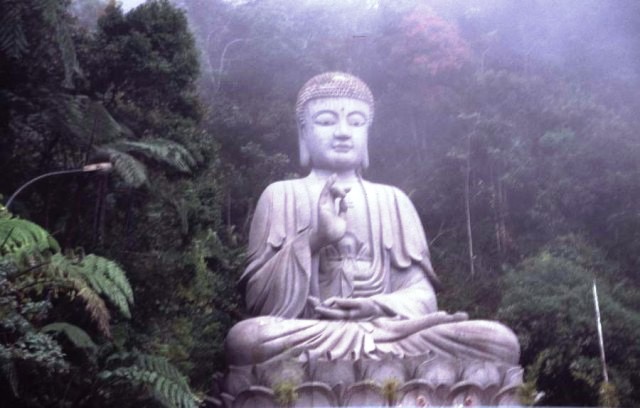
What Would Buddha Do?

Buddha

Solitaire Definement

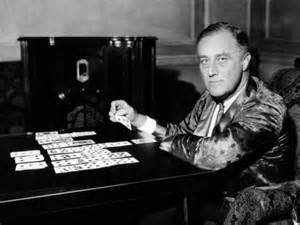
FDR playing solitaire A couple of weeks ago I saw a cartoon of a child watching her father play solitaire with a deck of cards. She says, “I didn’t know you could play solitaire without a computer.” I sometimes play solitaire on my laptop, a solitary vice but hardly an addiction. It could be a meditative exercise or a waste of time, or both. Sometimes when I am mindlessly clicking through the digital deck, I will be treated to vivid memory replays of scenes from my past, or a story plot problem will solve itself. I once wrote a short story about a game of solitaire that kept repeating, the exact same cards, time after time. Being human, I discover (mistaken) patterns in the order of cards and devise (pointless) strategies against randomness. If I play with troubles on my mind, I lose.

During one particularly egregious series of losses I came to wonder how many ways I could lose. On line I discovered the following:

How many possible games of solitaire?

A well shuffled deck of cards has a lot of possibilities. How many exactly? You can think of it this way. The first card you put down can be any one of 52 possible cards. The next card can be any one of the 51 remaining cards. The next can be any one of the remaining 50, and so on. This is expressed mathematically as 52! (52 factorial) possibilities for different arrangements of the cards in a shuffled deck. That means:

52! = 52 * 51 * 50 * … * 3 * 2 * 1 = 8.07 * 10^67
That’s 8 with 67 zeros after it. Which is a lot of possible arrangements for the cards. Think about it this way. Let’s say you took 7 billion human beings (roughly the number of humans on the planet today) and you had them play 100 games of solitaire each, every single day, for the next 10,000 years. In other words, the entire human race will be doing nothing but playing solitaire for 10,000 years. How many games is that? It’s:

7,000,000,000 * 100 * 365 * 10,000 = 2,555, 000,000,000,000,000 = 2.555 * 10^18
In other words, all of that solitaire playing does not even begin to put a dent in all the possible games of solitaire.

So, assuming well-shuffled decks of cards, it is quite possible that every game of solitaire ever played has been unique. If you shuffle a deck of cards, lay it out and play a game of solitaire right now, chances are that you are the only person who has ever played that particular configuration of cards, and it will never be played again.

That made me feel special. Participating in a 1 in 10 to the 67th event is as close as I’ll ever get to the infinite.

What are the odds of winning a game of solitaire?

The only way to answer that question is to play lots of games of solitaire and see what the average is. Fortunately someone has taken the time to do that. He claims that if you are playing normal “Draw 3 cards, keep going around deck” (Klondike) solitaire your odds of winning are roughly 1 out of 6 games. I don’t believe him, but then my laptop doesn’t let me cheat. Is there an app for that?

Roundtrip Journeyman

Cities I Have Walked This Way

(looking for sense in the time map)

Buffalo, Boston, Manhattan, Dublin, London,Frankfurt, San Francisco, Copenhagen, Berkeley, Charleston, Portland, Honolulu, Venice, Bozeman, Paris, Stockholm, New Orleans, Hong Kong, Chicago, Apia, Suva, Seattle, Sydney and Townsville and Auckland, at least

Take it to the wall again tonight, bro.

Finish the bottle and the cigarettes.

You’re not there yet. Take it to the streets

long after midnight. At the market

women are sleeping beside their taro.

Taxis are taking the last whores home.

Take it to the waterfront where always

everywhere men are awake with their

cigarettes. Walk it past the police station,

let the back street dogs bark at you.

Take it back to your indigenous city jungle,

walking like a ghost that casts a shadow.

Take it back, reclaim your birthright—

lost nights on the street like a swollen

scabbed-over fist, a bad cup of coffee,

a women in your brain driving you crazy and

a long walk home where you don’t want to be

because the words won’t begin and

the bottles are empty and the bed

is a succubus. Walk it off, shake it off,

city boy. Disappear in an alley way,

walk through that wall to survive.

(from 14 Degrees South, John Enright © 2012)

*   *   *   *

“I think you travel to search and you come back home to find yourself there.”
― Chimamanda Ngozi Adichie

*   *   *   *

3700 miles later, Connie and I drive back across the Jamestown Bridge from Kingstown onto our home island, making this a roundtrip. We have been dodging weather all the way up, waiting for windows of warmth to the north. Not all journeys are roundtrips. There have been many places of no return, just passing through.

There have been hitchhiker wandering times in my life when I would wonder if the strange town I was hiking into with just a pack on my back would become a terminus destination. I might meet some woman in a bar, find some seasonal work; and the next thing I’d know it would be three seasons later, she’d be pregnant, and I’d just bought her a used washing machine. That almost happened a couple of times. Life would have been different. Fate is just another name for happenstance. Chaos shrugs off determination. One of them was named Petranella, warmth in a Montana winter.

In and out of time, like traveling from state to state. There is nothing as timeless as an empty highway, where your mind is free. The future is ahead, speeding toward you, but you can’t see it. Or think of it this way—that you and the present are stationary, unmoving, and the world and time are speeding past you.

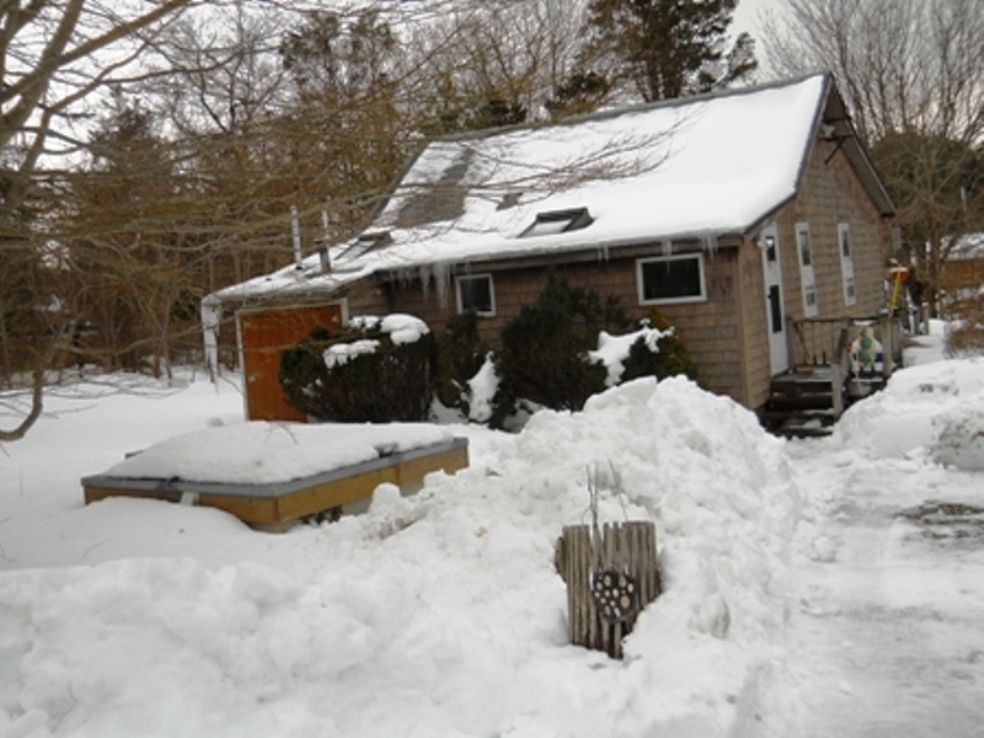
home Back to our cabin buried in snow where the road ends at the woods, a single deer track through the drifts. The Weather Channel has made it from Juno to Thor in the naming of storms in our absence. I turn my cell phone back on. The six weeks of collected mail is mostly bills. The first night back my dreams are all of Samoa and filled with the dead. Is déjà vu caused by past dreams of the future? In Florida the most common birds were the always effortlessly circling vultures.

Roundtrip. Desert nomads followed a cycle, always moving, always returning. No true navigator ever set sail thinking that he could never return. We come home and find ourselves, like an imprint in a favorite chair.