Canisius High School Class Of ’63

Canisius RingsIt’s that time of year. Caps and gowns time. Canisius is the Jesuit high school in Buffalo that I graduated from 52 years ago.


Canisius High School Class of ’63

They say that armies are always trained
to re-fight the war that they last won.
Four years of Latin and a whole homeroom
lost to Greek; Father Riesert’s giant
slide rule above the blackboard of his
physics classroom; the unheated pool
where we naked water polo warred.
All the past was invested in us—
Caesar’s Gallic Wars and Shakespeare,
authority’s unquestioned dominance,
the sport coats and ties, dictated haircuts,
pride of place, and fear of jug.

All that was before.

Before Nam and napalm,
before Jimi Hendrix and the pill,
before foot prints on the moon,
before Joan Baez or hash brownies,
before satellites linking and stealing
our lives, or all the glaciers melting.

We who were born with the bomb
can bear witness to the before and after.
We have watched it all change—
black holes replacing purgatory,
irony supplanting orthodoxy.
Even the number of dimensions
has expanded beyond comprehension.

Amo, amas, amat — the first Latin
we were taught in freshman year.
Those Jesuits, they just sent us out
as raw recruits onto a battlefield
that Ignatius could never begin to imagine.
Would he have a website or a blog?
It has all been an end-game of sorts.
Whatever comes next will be more desperate.
But we did the best we could.
The end of the past follows us & just as well.
The future will be its own orphan.

Archival

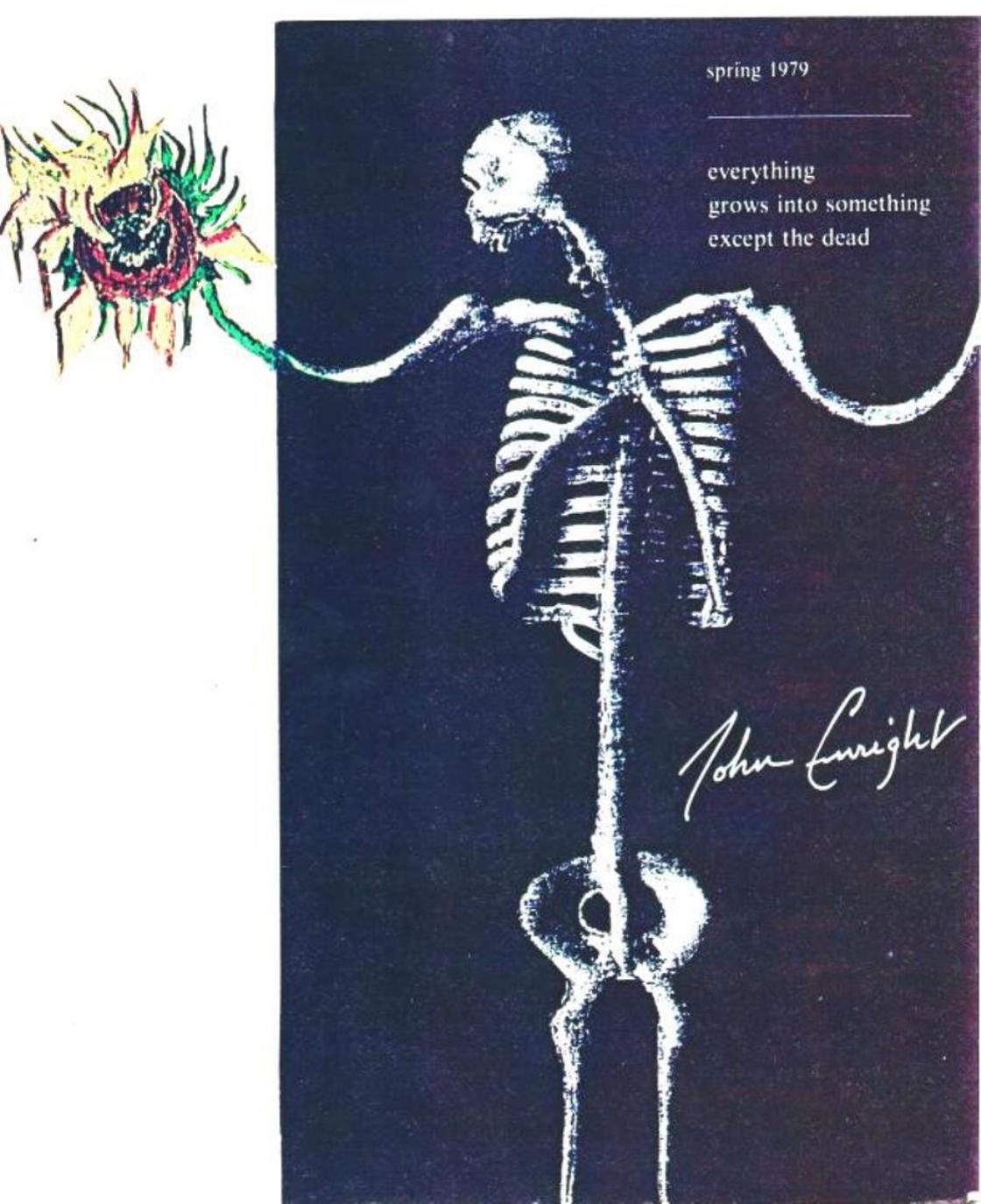
Everything grows into somethingThe folks at the Special Collections and Archives of the University of Rhode Island Library have agreed to take my journals and papers for safe-keeping. So, for the past few days I have been busy getting all that in order to say goodbye to. The library gave me boxes in which to stash it all—fifty years’ worth, maybe 10,000 pages in all. The oldest of these files have followed me from Harlem to Berkeley to New Jersey to San Francisco to Samoa to Rhode Island. The 26 years of Samoa papers still retain the fond moldy smell of the islands.

There are at least a thousand poems and hundreds of pieces of both finished and abandoned prose to sort through. Every time I moved I threw away more than I kept, but there is still too much. I sort it all through yet another, final filter, filling black garbage bags with the less than necessary. So much paper waste—I have not lived a forest friendly life. But I do get to revisit raising my son in the benign bush of Tutuila and re-fear cyclones I had forgotten.

I’ll share a few pieces here, all from decades ago.

Desire

I want a t-shirt
that says on its back
Use Other Side First.
 
I want a ticket
that no one will question,
a friend in high places.
 
I want a history
where no one is named
and facts have no dates
 
but eons have names
like Nancy and Jane
where nothing happens.
 
Please pass the eraser.
Between us we can
get somewhere fast.
 
I just feel it rising
out of the sidewalk
and into my soul
 
nothing that I ever
needed or wanted
as naked as I am
 
as useless as cops
as salty as sex
as open as a wound.
 
I want an old day
to stop by and visit
to sit by the window
 
and tell me about
what the king will say
to the queen when they
 
finally are left alone
and all her sorrows
have dissolved in tears.


Santa Pajama

Santa Pajama was a bedroom community just up the coast from Vaudville. We drove up the coast road. The ocean was so calm it looked asleep. Samantha slathered sunblock onto her arms and face and shoulders. It was May.

When we got there I couldn’t find the place. I kept rereading the directions she’d taken down over the phone and kept getting lost. Samantha pretended to sleep.

What I finally found was the wrong place on the boardwalk above the beach. But the people there knew who Buddy was and sent us to a bar on the Vista Verde where we could find him. He wasn’t there but Samantha knew the bartender — remembered him from a Shinto halfway house up in Nofloss — so we stayed and drank diet maitais.

I found Buddy’s phone number on the on the toilet partition in the men’s room. I left a message for him on the machine that answered at a Swedish phonesex service. When I went back to the bar Samantha was gone and there was a new bartender. Her purse was still on the floor beside her empty barstool.

I slept in the car, in the back seat. I’m short. In the morning a 13 year old girl wearing a pair of men’s peach jockey shorts as a halter top and a pair of Italian roller skates was asleep in the front seat. I married her. We’ve got three kids now. We don’t live there anymore.


abc

anyway
because
creation
demands
eternal
fasting
gorging
healing
in order
just to know
looping
meaningless
nevertheless
operationally
pertinent
questions re:
recording
some-
times
unrelated
verasimilitudes
without which
xyz

Specs’ Saloon, North Beach, San Francisco

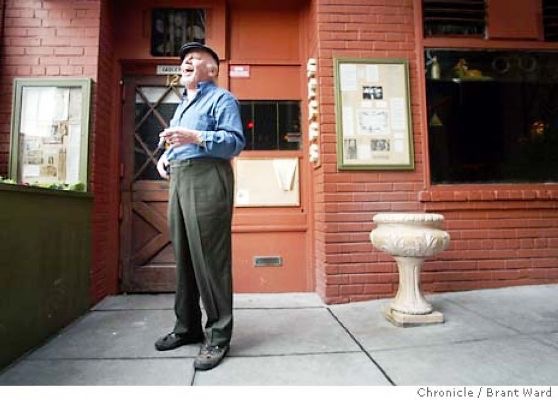
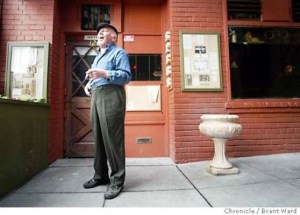
Specs

Specs himself outside his saloon, having a smoke and a laugh, 2004

Someone observed about the Buffalo I grew up in that there seemed to be a church on every block and two saloons at every intersection. They were all filled with good Christians. The typical neighborhood tavern carried the proprietor’s family name—Strinka’s, say, or Topolski’s or O’Connor’s—and had two entrances, one to the bar in front and another family entrance in the rear to the dining room. As most of the city was Catholic, these family entrances got most of their traffic on Fridays around dinner time, because the tavern’s cheap fish fry was a housewife’s welcome alternative to stinking up the house with the smell of cooking fish. And it was payday.

It was a blue-collar world. A shot of schnapps and a draft cost you fifty cents. For many the corner barroom was like another room on their house—a room free of family and kids. There were no TVs above the bar, no sports channels, and if there was a juke box it wasn’t tolerated during prime drinking hours, dusk to midnight, and for half the year dusk came early to Buffalo. Patrons either quietly conversed or sat alone inside the blessed freedom of their chosen cone of silence, studying their drinks and cigarettes, communing only with themselves and maybe their reflection in the back-bar mirror behind its picket fence of whiskey bottles. Normally everyone there would be a regular, and after a while bits of personal history would become absorbed as common knowledge and the men and women behind the bar became not just the dispensers of self-medication but also the reference librarians of local lore and current events.

“I haven’t seen Murphy in here in a week.”
“It’s his back again. You remember his accident.”
“Did the union ever get them assholes to settle?”
“I guess they’re paying for another operation.”
“How’s his wife doing?”
“She’s off the drink, too, I think. Hasn’t been in. Want another?”

If Murphy didn’t make it, there would be a collection for the widow and the kids.

I entered this world when I was seventeen, and for the next twenty years—until I moved to Samoa—neighborhood bars, no matter where they were, would be my wayside chapels of peace and familiarity. If during that time the Catholic Church ditched Latin as its unifying language, corner saloons still spoke the same lingo of escape and observed a consistent liturgy of nonjudgmental sanctuary, filled with your fellow faithful. Homes away from home, the other room to your ancestral house that you could always find if you walked the streets and could interpret the neon semiotics of barroom windows.

I spent several years visiting, photographing, and researching the scattered remaining historic saloons of the California Gold Rush and Nevada Mother Lode country for a book I never wrote. I used to pride myself if plopped down in a new town—at a Greyhound Bus Station say—of being able to find on instinct the nearest convivial watering hole. I wonder how many thousands of such places I’ve walked into, just a stranger coming in the door and taking a stool at the bar and ordering a drink. Just do it right and nobody will ever question you. It is like entering a church and dipping your right hand into the holy water font and blessing yourself and genuflecting properly before the altar. In twenty years no one ever challenged me or tried to pick a quarrel. From Hong Kong to Belfast, in twenty different countries and every state of the union the sacrament was the same.

And so it was in North Beach where I found Specs’. I never lived in that part of San Francisco, but Specs’ became my neighborhood bar. I am a tad superstitious about talking about Specs’, because the place, which absorbed me forty years ago, is still there, just off Columbus Avenue on old Adler (now Saroyan) Alley, unchanged, ungentrified, and I am afeared to jinx its existence by writing about it as history. (Is this aging, when you begin to feel some responsibility for the past, some complicity with its integrity and survival?) I moved often in those years, both around and away from the Bay Area, but Specs’ Museum and Saloon remained a sort of borrowed nexus, the place where people could find me if I was in town or leave messages for me if I wasn’t. A place to find connections for work or the next apartment to rent or a new lover. But mainly it was a place to talk, a bohemian wayback machine. Again there was no TV set in the place nor a juke box. The bartenders were Irish maestros of gab. I made some good friends there, folks always ready to pick up the talk no matter where it had left off, folks who just wanted cohorts and a space to enjoy the end of their day.

A number of years ago I stopped in Specs’ on my way through San Francisco to somewhere else. It had been three or four years since my last in transit visit. I hung out at City Lights Books across the avenue until Specs’ opened after four. I took my old seat at the end of the bar between the front window and the reading lamp and opened a book I’d just bought. The bartender, a younger man whom I’d never seen before, was busy setting up the bar for business. I didn’t bother him with an order. All the memorabilia of the bar—the flags and shark jaws, old union posters and ironic signs, scrimshaw and Inuit art, framed newspaper headlines and eclectic photos—were all still in there proper places, all sepia stained like Civil War prints by decades of cigarette smoke. Then a green sixteen-ounce can of Rainer Ale appeared on a coaster in front of me. Green Death we used to call it, the strongest, most assertive brew you could buy there, the usual opening drink of the old sundown regulars thirty-five years before.

“What’s this?” I said to the unknown barkeep.
“You’re Enright, aren’t ya?” he answered, straight out of Dublin. “And that’s your usual, ain’t it? Where ya bin?”

I came back late that night, before closing. A different crowd, all younger, only a few of the old, hobbled and roseola-nosed regulars left. I came back to see the eponymous proprietor Richard “Specs” Simmons himself, who, dapper still in his 70s, would stop by to judge the closing crowd. We were glad to meet. We sat at a table near the front and talked the present about the past, as men will, catching up on people and their personal events—Deborah’s kids, Marilyn’s last known success, Kent’s funeral. Since my previous visit San Francisco had passed a law against tobacco smoking in all public places, including saloons, and now the dead-end pedestrian alleyway in front of Specs’ often held the best conversations, as smokers followed one another outside, placing coasters on top of their drinks on the bar. But when Specs lit a cigarette without moving from his table, I did too.

“It’s my place, after all,” he said. “If anyone wants to file a complaint, then fuck ‘em. They’re eighty-sixed forever and may they remain eternally childless.” He took a drag. “And I’ll gladly pay the fucking fine.”

Usual Group at the Window Table
____________________

How in Westerns the wheels of the wagons
always spin backwards the faster they go,
how ice and flame at first touch feel the same.
Take a pint and a seat by the window.

If all my sins were confessed in Islam
my body would have no extremities.
What do you call what you want to forget?
Take a pint and a seat by the window.

There are faults in the sky that insult me,
slick birds with no wings that call themselves souls.
Without your lost beauty no one knows you.
Take a pint and a seat by the window

Hong Kong / Vows / 1976

Hong KongI gave it all away, all the cash I had on me down to my least coin. It was like feeding chickens. That back street in Kowloon was famous for its beggars, and once I started handing out cash it didn’t take long. Pierre Cardin suit, Italian shoes, silk tie, a foot taller than all the poor dudes that crowded around me. In my coat pocket was my final purchase—a pint of Wild Turkey. I remember it was a chilly night, December. Of course, I had a hotel room to go back to, and the next day I could go to the bank and get more cash, but I was celebrating my freedom by giving away my chains.

Seventy-six was a tough year, my thirtieth—burn out and break down at my editor’s job in Berkeley, a state of imploding confusion in my so-called love life, shrinks and drugs and a growing fear of others. There was the odd but deeply felt conviction that I didn’t want a future, but I had zero attraction to thoughts of suicide. I didn’t want to perform; I just wanted to wander and watch. It had taken me less than a month to get sacked from my Hong Kong editing job.

A couple of nights before that night in Kowloon I had done a Kiwi bloke I had met the favor of taking him to a respectable whorehouse. He was headed off to an Arctic oil rig for six months and wanted a weekend of companionship to send him off. I knew where to take him from wandering and watching, not from performing. The American Nam thing was winding down, and there were a lot of under-employed prostitutes in Hong Kong now that the Yanks were no longer coming there for R and R. He picked his girl out of the second group the Mamasan sent over to our booth. He seemed happy and I got up to leave. Only Mamasan wouldn’t let me. She and a line of her girls blocked the door. What about me? Her girls weren’t good enough for me? By now some of the girls were cursing me in Cantonese and others were crying and running away. Mamasan picked up a bottle and waved me away from the door. The Kiwi bloke was laughing, but it wasn’t funny. Mamasan yelled something toward the back of the room, and the most attractive, princess-petite girl we had yet seen, dressed in a slit green silk kimono, stepped through a bead curtain. I would take her, Mamasan insisted. But I’m a priest, I told her. Ha, she said, priests like it more than most. Mamasan walked over to take the shy girl by the arm and bring her to me. I bolted for the exit, shouldering aside the girls who tried to stop me. They clawed at my back as I got the door open and hit the street running. Those words, but I’m a priest—that lie—stuck with me. Why not undo the lie and become a priest?

There are three vows—poverty, chastity, and obedience. You can’t grow up Irish Catholic without knowing that. I had a brother who was a priest. So, I decided to start with the first vow, poverty, and gave away all my cash. But that was just symbolic. I had decided that what a vow meant was to disavow all interest in what the vow forbade. Henceforward, money would be a null set. If I had some, fine; if I didn’t, fine. Its accumulation would no longer be of any interest to me, no longer any sort of index of success or failure. As I gave my cash to the beggars on that cold Kowloon back street, I smiled and said, “Null set, null set,” and they smiled back, nodding, saying “Nur sut, nur sut.” We had a great time.

I moved out to Zhang Zhou then, a tiny island on the outer edge of Hong Kong Territory, where there were no roads or vehicles and a room was cheap, a two hour ferry ride from downtown. A junk with an eternal oil slick trailing from it was anchored in the rock-bound cove outside my window. I considered the other two vows. I knew enough about the history of Christian chastity to know that it wasn’t about fucking but about non-attachment to the non-spiritual. I couldn’t imagine denying my impulse to fuck, but I had non-attachment down cold, as it were. If I couldn’t make a virtue out of that, I might at least employ it as an armoring vow. Obedience was the bigger problem. Thirteen years before the Jesuits had rejected me because of my psychological problems with authority. But I found a way around that one, too. I would pledge my obedience to myself, that inner self I had always fought with. If it said head north, I’d head north. If it said find a place to hide, I’d find a hideout. If it told me all this is wrong, I’d drop it and leave. One morning the junk and its oil slick were gone.

I tried to live that way the next five years, on the road a lot. For a while a few people worried about me, but they got tired of that and left me alone. I didn’t make much money, but I didn’t starve. All in all I don’t think vows are a very good idea—that authority thing again. After a while I was happiest when I forgot them and just got on with what I was doing, though I was still broke.

Heisenberg und Heimatlos

Heisenberg

Werner Heisenberg

Yeah, and sometimes reality salad sucks. Yesterday the landlord stopped by to tell us our time here is up. It’s been almost eight years, but the family needs the cabin back, the next generation asserting its priority. Time for the gypsies to move on along. That’s life for a renter, and I have never been anything but. The biggest thing I have ever owned was a pickup truck. I don’t get to use words like equity or liquidity. It’s cleaning deposit and last-month’s rent.

I have no idea where we will go. We can’t afford much locally. Again we are faced with the imminent uncertainty of being homeless. This was more entertaining forty years ago, when uncertainty still held some sense of adventure. And at our age—freshman septuagenarians—there is a certain moral stain attached to not having our fiscal and domicile acts together, surrounded as we are by peers safely cushioned by their savings and entitlements and homes.

Werner Heisenberg is, of course, best known for his uncertainty principle, first introduced in 1927, which in its simplest version states that the more precisely the position of some particle is determined, the less precisely its momentum can be predicted. The metaphoric existential applications beyond quantum mechanics are enlightening and reassuring. Uncertainty is a given. You can’t predict where you will be from where you are now. For all living entities the sole certainty is death. If you are a renter don’t go feeling secure. Shit happens.

Olson’s line: The only thing that does not change / is the will to change.

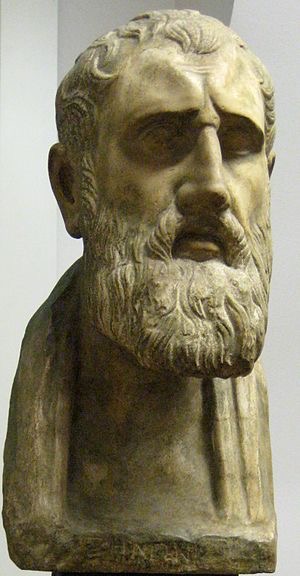
Zeno of Citium

Zeno(letter to Michael Joyce)

Mika:

It is popular and easy to pick on the American male psyche, its blind spots and delusions (e.g., TV ads). We all know who we are and to what extent we replicate the typification. (Robin Williams to Nathan Lane: “I didn’t know John Wayne walked that way.”) It’s a camouflage we all learn young, and some of it grafts into personal armor. Fate knows that we have all escaped bad situations by pretending to be brave and have acted the total dolt in matters hormonal. But tonight I would like to signal out one trait of that cowboy outfit for acknowledgement–Stoicism, no matter how tepidly preserved.
Ranger Zeno of Citium, please step forward; yes, you there, the one not paying attention.

Veterans won’t talk about their wounds. Baseball players cannot rub the spot where it got ’em. Hockey players aren’t allowed to cry. I can get by with, I got out of the hospital Friday. We’ll see what the bill will be. Gotta love it. Home, convalescing, a basketfull of pills to take. No big deal. At the end of how many half-hour shows was Hopalong “just winged,” with his arm in a casual sling as he rode away into the credits? A couple of slugs of saloon rotgut were all the Duke needed before going under the dirty doctor’s knife. “No pain, no gain” bullshit.

I have been in pain as long as I can remember. Pain has been a constant companion, and mostly a secret stalker. It was just another thing to hide. I don’t want to go there tonight, to examining life as a list of what I’ve had to hide. (Although, that is an interesting idea.) I’m just glad I don’t have to talk about it. Besides, I’d misspell a bunch of the med terms and drug names, and, really, who cares? It’s no autopsy.

Of course, a true stoic would also be given to showing no interest in joy as well as in pain. Did they see the difference and manage to treat them the same? Or was it just an emotive control thing? They were all Mediterraneans, after all.  It was no joke in my Irish family that emotions were things that other people had, like Italians. (So I married one.)  But I like our customized American version of masculine stoic, where good shit can be acknowledged but not featured. Pass out the cigars; no need for the obstetric details.

I have again escaped the tubes and needles, and it is Act One of Another Spring. We’ve rehearsed this ten thousand forests before–the dead gray dirt rises up and covers itself then everything else in a verdant blanket of dense, frantic reproduction. Mind-boggling every time.

The stoic accepts what is. The sage is the one with the fewest illusions. I am dying. But I am going to take my fucking time about it. So may we all.

Ioane

Baseball

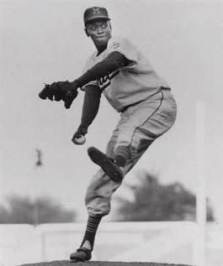
Satchel Paige

Satchel Paige

It is that blessed time of year again, when the season opens in uncertainty and hope. When new guys blaze across the outfield, slamming into fences, and superannuated sluggers acquiesce to the role of designated hitter. Five months ahead of games behind and on base percentage. A pleasure except for all those goddamn truck ads.

I played a lot of baseball. When I was a kid it defined the months when there was no snow on the ground. I was good at it, but never big enough or strong enough to be more than just good. I was a catcher mostly, and what I liked about the game was that even if you weren’t the best you could often out-think them. I made it to semi-pro in the summer of my seventeenth year, catching for Hewitt-Robbins in the Greater Buffalo Industrial League. They paid me when we won. Then I discovered other things, like girls and the private joys of wandering. When I was a kid I measured the worth of things in catcher’s mitts. Top of the line was about twenty-five bucks, four to a hundred, forty to a thousand. The day my dad sprung for a pair of pricey (one catcher’s mitt) kangaroo-skin spikes I knew he truly loved me. I had a good arm but had trouble hitting the slippery shit that the old guys threw.


Easter, Passover, Opening Day
________________

Another thing I like about baseball
is that they don’t give anyone
whistles to blow or buzzers to
set off or only so many time outs.
As my wife says, it’s real time
and therefore gets to set its own pace.
I describe to her how
your hands sting in early April
when it’s forty degrees out and you
foul off an inside fastball.

What’s so cruel about spring
is that it’s not yet summer,
dusk comes too soon, and everything
must start again in mud and hope.


The Throw to Second
_____________________

If your body can’t—if blind you can’t—
make that throw to second in your dreams
you got no business catching.
The mitt goes down and out
like the weight on a catapult and
from behind your right ear the ball is launched
with a peculiar straight-arm snap of the wrist.
It’s a throw unlike any other,
a bazooka’s accuracy or nothing.
Explosion has no grace. You end up
on your face or close to it.
The shortstop’s safe because
the throw was there in time
to cancel the slider’s need for spikes
and you’ve nailed the sucker.


Leroy Satchel Paige
__________________

The soul of any journey
is its unendedness,
therefore all our heroes
should be those who just
refused to fucking stop.

Like someone who at 42
began his “rookie” season
in the show with Cleveland
some thousand wins behind him
in the Negro Leagues, the bush

which counted for zip in
the real books, the white books
the history of the bigs.
Like some unpublished Homer
some hero of an unknown kingdom

an ageless sage playing baseball
in a shadow world of greatness
ever moving—Mobile to
Chattanooga, Pittsburgh to
K.C., Cleveland to the Cards.

At 59 he was still throwing
shutout innings for the A’s.
Excuse me if I stare
trying to see who’s pitching there
extra innings after midnight.


The Zen of Baseball

Satchel Paige didn’t throw fastballs
or curve balls or sliders. He threw
what he called the trouble ball
along with the bat dodger and bee-ball.
He called it the bee-ball because
“it be right where I want it to be.”

He was a skinny dude and I bet
he hid the ball well and worked fast.
I would have liked to catch for him.
Somehow I would know where he wanted
the target of my mitt to be
—bat dodger down and away.

The Zen part is we wouldn’t keep score,
no stats, just the next swing and miss.

(Poems from 14 Degrees South, University of the South Pacific Press, © John Enright, 2012)

Tough Guys

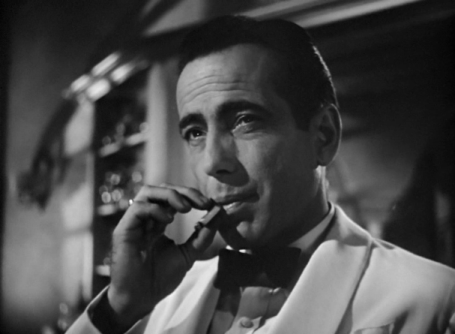
Humphrey Bogary “He looked at me as if I was a cigarette stub, or an empty chair. Just something in his line of vision, without interest for him.” (R. Chandler, The Long Goodbye)

Immersing myself in old-shelf Hammett, Chandler, and Cain, their folk art, indulging the Bogart in me. At the local public Jamestown Philomenian Library (no one knows what that middle word is supposed to mean) the separate shelf space for mysteries is almost as large as the shelf space for all the rest of adult fiction. I wonder why I stayed away from it so long. There are even large-print editions of some of the classics, for us old folks, who remember the original editions.

Sure, the plots are familiar, but the plots aren’t really what the stories are about. They are all about self-knowledge—not deep self-knowledge, just a sure awareness of what’s coming down and how ego—the personal third-person, hardly omniscient narrator—will react to it. The goal of each story is our man not having to alter or even seriously question—much less apologize for—his sense of himself. The ones that get roughed up are the best at this.

You got to like these guys. Shamus surely should be a cognate of shaman. Anchorites on the edge, approached only for their special knowledge and extra-societal competence. The rules are made to be broken. I glimpse features of Amerindian trickster heroes here—coyote unbound by politesse—and the Wild West tall-tale. An American hero, someone your wife would never invite twice for dinner. That dangerous friend.

The only way to solve a mystery is to become caught up in it. And, of course, the babes are always young and comely, decked out in bespoke Hollywood innocence, but always with their own agendas. Lashed to the mast of his low-life craft, our man is tempted but does not yield. Babes are nothing but trouble. The streets are noir. There is no gore. The dialogue is repartee.

Like the words on the page, it’s a black and white world, but with shades of gray in the best. Those are a sort of history, snapshot albums of an American time when men wore fedoras and cars had running boards. Chandler’s Los Angeles and Hammett’s San Francisco are more real than what is there today. The Greatest Generation Tom Brokaw called them, the tough guys. Once they were role models, cigarettes and all.

Our Fear Of Food

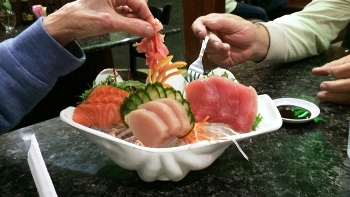
Eating raw

Eating Raw (Photo: L. Ellis)

Along with all the other things that today’s Americans have been trained to fear—Arabs, microbes, liberals, aging, immigrants, erectile dysfunction—is food. Food prejudice has become so common place as a personality trait that there is a full Internet smorgasbord of groups you can choose from to join of like-thinking devotees to your particular anti-taste.

Certainly, food taboos are as old as indigestion. Leviticus raised diet no-nos to an alchemical art form, with abominations based on abstract theories of the pure and the impure. Why is it again I can’t eat rock badger? (Did Leviticus suffer from a gastro-intestinal complaint? We know that Martin Luther was tortured by constipation.) Sure, lots of it made sense—Uncle Fred ate that and died. Every species figures out what it can and cannot eat. Nothing mystical or even mysterious about that. But the secret to our species’ frightening success is its rare and wondrous feat of being omnivorous. We even learned how to leach and cook the bad stuff out of poisonous food.

One of the revelations that remains with me from Stephen E. Ambrose’s wonderful saga of the Lewis & Clark Expedition Undaunted Courage is the description of what the expedition members ate on their multi-year trek. For weeks it might be just meat—bear or buffalo or horse or dog—then just foraged roots and berries for a while. Hard tack biscuit and salt beef for a spell? Fine. Those guys would eat (and drink) anything, and none of them died from their diet.

I was certainly raised to eat whatever was put in front of me. Sure, I had my favorites, but I did not pass the turnips without taking some. They weren’t punishment; they were food. Nothing to fear. Put some butter on them. Growing up, I never knew anyone with a food allergy other than lactose intolerance, which was a drag because she couldn’t eat ice cream. Nothing to brag about there. Nobody passed on the peanut brittle. Of course, our diets were limited. Our Irish American mothers never cooked Italian, for instance, which is why pizza places were such a hit when they arrived in our teenage years.

My first introduction to food as something other than just food came in the home of my name-same uncle Dr. John Enright, a family doctor (they weren’t called practioners yet) in Buffalo. I was maybe ten and was there for dinner. Uncle John would borrow me now and then because he had just girls. Reconstructing the scene from facts gleaned later in life, I think Uncle John had discovered the recently available Oesterizer blender and was experimenting on his family’s digestive systems by serving them food that they did not have to chew. On our plates were three mounds of mush—brown (meat), green (veggie), and white (carbs). I ate it, but I thought it was weird. I thought maybe I should be blind-folded as well, then led back to a cell.

Beggars can’t be choosers is among the most blatantly true clichés. And you can be on a socio-economic rung or two above beggar class to personally attest to the fact that the hungry can’t be picky. I do not want to look up the U.N. number of how many millions of children went to bed hungry tonight. (I get up to fix myself a snack of cheese and crackers.) Facts like that stop everything, and I do not want to stop. I want to go on about this fear of food thing. I just wanted to remind us of the reality, of the fact that our parents and their parents and theirs back to our let’s-get-out-of-the-trees ancestors were thankful for their daily gluten, for whatever they could get to eat. And happiness was going to bed with something in your stomach besides empty rumblings.

Fear. What a powerful cultural force fear is. If you can control what people fear, you can control them. Human communities were born because of fear and its perceived countervailing safety in numbers. A savage was once sauvage, just someone who lived outside the walls. The fear of death was used to ritualize and control the lives of our predecessors. Fear—fight or flight—and its resultant pheromones are as basic to our nature and survival as the reproductive imperative and its raging hormones. Only, fears are learned, and they are contagious. There are both rational and irrational fears, but the defining adjective does not alter their efficacy.

We have a word for irrational fears—phobias. The suffix phobic has become as familiar as backward baseball caps in America. As our contextual world has expanded, so has the universe of things to be afraid of. In some ways our phobias have come to define us. I know a woman who will not fly on any airlines with the word west in its name. Another friend, a nice guy but a filthy-lucre germaphobe, will not touch money. Perhaps it is because we are already protected from so many real dangers.

Food phobias constitute a special case, though. If we fear what we eat, and we are what we eat, does that make us fear itself?

Slow Motion

No need to surprise.

I’ve been surprised before

and it doesn’t last.

It’s the slow things now

that make me take notice.

Got something slow to show me?

How snow drifts disappear,

ditch water with nowhere to go?


You hear how catastrophes happen

always in slow-mo—the car

tumbling once then again,

stretching endtime like taffy

—half way to eternity, then

half way again, ad infinitum.