Jungle Beat Mysteries


Before Reality Salad there was Det. Sgt. Apelu Soifua. If you would like to visit American Samoa as if you had lived there for 25 years, Apelu will show you around. If you wonder what it is like to live in a colony where the laws did not evolve from the culture but were imposed upon it, Apelu will let you listen in. If you have never had to observe and live by two often disparate sets of cultural rules, Apelu will share some laughs with you.

The Det. Sgt. Apelu Soifua Jungle Beat Mystery Series is available from Amazon.com . Join Apelu. The only visa necessary is your openness. 

American Samoa a Century Ago

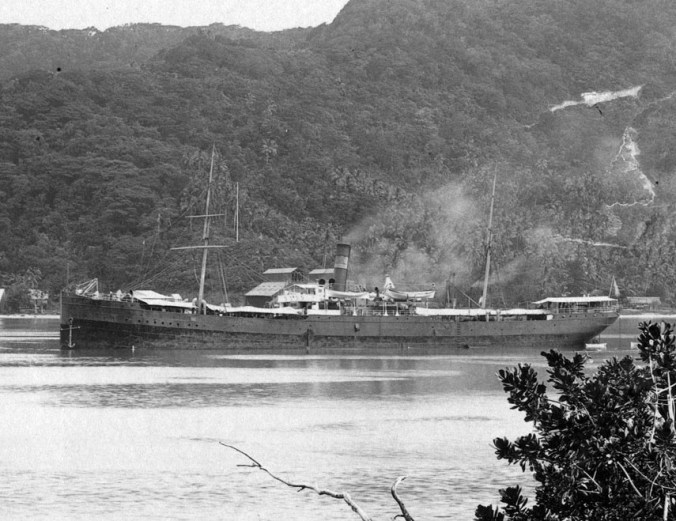
USS AbarendaUSS  Abarenda in Pago Pago Harbor, 1900

Karen Wheat is the author of a forthcoming book, Pictures of Change in Paradise at the Turn of the 20th Century, an annotated collection of photographs collected by her great great uncle Joseph L. Dwyer during his stay in American Samoa from 1907 to 1913. Karen asked me to write an historian’s end note to her handsome volume. It’s a bit long for a blog post, but I thought anyone interested in a brief introduction to American colonialism might be entertained. For a gripping and comprehensive description of this history see Joseph Kennedy’s The Tropical Frontier: America’s South Sea Colony.

Joseph L. Dwyer in Historic Perspective 

When the young Detroit lawyer Joseph Dwyer stepped ashore at the U.S. Naval Station Tutuila dock on Pago Pago Bay in May 1907 and found his land legs after five thousand miles at sea from San Francisco, he stepped into history—a backwater of history to be sure, but a place and a time that none of his peers back in Corktown would ever know. Out of every generation a few young men wander away from home, but very few venture this far away or into a culture from so distant an epoch. He was not yet thirty. One wonders what heartaches had set him free.

            Somehow Dwyer had gotten himself—a former navy yeoman—appointed by the Secretary of the Navy Josephus Daniels to be the civilian secretary to the commandant of U.S. Naval Station Tutuila, a commandant who also served as de-facto governor of the recently acquired isles. The U.S., after successfully subjugating all the native peoples of its continental territory, had only recently entered the game of global imperialism. The ten-week Spanish-American War in 1898 had almost effortlessly garnered Cuba, Puerto Rico, Guam, and the Philippines as stars-and-stripes territories. 1898 had also seen the annexation of Hawaii, and in 1899 the Treaty of Berlin had split the Samoan Archipelago into the suzerainities of Germany and the U.S.A. Dwyer was a factotum of the nascent American empire at the start of the American century.

            The first recorded European contact with Samoa occurred in 1722, when Dutch navigator Jacob Roggeveen sighted several of the islands. He was followed by French explorers Louis-Antoine de Bougainville in 1768 and Jean-Francois La Perouse in 1787. These were the astronauts of their era, going where no Europeans had gone before, sailing their culture’s most advanced vessels. Roggeveen named the islands The Navigator Isles, noting in his journal that the native crafts that came out to meet his ships sailed circles around him. He chose not to pause. Bougainville, too, sailed on by. La Perouse stopped to recharge his water casks and seek fresh victuals.

            On the north shore of Tutuila, in the now deserted village of A`asu, is a monument set up by the government of France to memorialize the dozen French sailors from the La Perouse expedition killed there in the initial meeting of Europeans and Samoans. “Massacre Bay” they called it. The monument is on the National Register of Historic Places. There is no monument to the 39 Samoan warriors who also died in that first meeting. For decades after, Western ships refused to call at the islands for fear of a similar welcome.

            The first European Christian missionary, Englishman John Williams of the London Missionary Society, arrived in 1832. Williams and his followers had a profound impact on Samoans and their culture. Other missions lead by the Catholic Church and the Church of Latter Day Saints followed. Samoans were thoroughly Christianized before the U.S. Navy arrived.

            The five small islands (total land area 76 square miles) of Eastern (now American) Samoa were high and volcanic with a population fewer than 7000 (99% Samoan) when Dwyer arrived. In 1900 when the high chiefs on the main island of Tutuila had placed their Xs on the Deed of Cession that had been prepared for them, they basically made a gift of their island to the President of the United States (McKinley at the time), who promptly turned their governance over to the U.S. Navy. It was the navy that had pushed for the acquisition, as they wanted the protected harbor at Pago Pago as a coaling station on the long voyage between Hawaii and New Zealand. Ironically, by 1900 almost the entire U.S. fleet had been converted from coal- to oil-fueled.

            In April 1900, the USS Abarenda—hardly a gunboat, but one of the navy’s few remaining colliers—arrived in Pago Pago harbor. Within a week the Deed of Cession had been signed and the American flag raised above the nation’s latest possession, its sole territory in the Southern Hemisphere. The Samoans were pleased to have Uncle Sam rather than the Kaiser as their new landlord, and the first commandant, Cdr. Benjamin Tilley, was diplomatic and made a good impression. By the time of Dwyer’s arrival seven years and three governors later, a proper naval station had been built in the village of Fagatogo adjacent to the dock and coal sheds. A small station ship that did double duty as a tug boat had replaced the Abarenda, but there were few visiting vessels. The coal, unused and not available for sale, had to be constantly watched and shifted to prevent it from spontaneously combusting in the tropical heat of the sheds.

            In America, the name Pago Pago had come to denote a place like Timbuktu, impossibly remote, the edge of the world. To the naval officers assigned shore duty at Naval Station Tutuila it must have seemed a demeaning posting—as if they could not be trusted with a real ship, real duties. Annapolis had not trained them to be civic officials. They had been trained to navigate, to fight sea battles, and to keep a disciplined ship. They brought what skills they had in human relations. They complained about the steaming climate and looked forward to their next assignment, wherever it was.

            The majority of the U.S. Naval officer corps at that time was from the South. Many of them maintained the racialist assumptions of their culture and background. (The U.S. Navy at that time was officially segregated. Not until 1942 did the navy begin accepting African-Americans for general service. There would be no African-American naval officers until 1944.) These attitudes and assumptions would underlay many of the naval governors’ official acts. (There would be 30 naval governors before the navy gave up control to the Dept. of the Interior in 1951.) Many Naval Station commandants dealt with their command as if it were a ship and the native Samoans just unfortunate cargo.

            This attitude was shared by most of their superiors in Washington, by the U.S. Congress (which has to this date not deemed it necessary to enter into a treaty or organic act with American Samoa to change its status to something other than a gift), and even the United States Supreme Court. In its infamous Insular Cases of 1901, the court squirmed to justify the U.S.’s new colonialist avatar under an anti-colonialist Constitution. In Downes v. Bidwell (182 U.S. at 286), Justice Brown wrote: If [distant] possessions are inhabited by alien races, differing from us in religion, customs, laws, methods of taxation and modes of thought, the administration of government and justice, according to Anglo-Saxon principles, may for a time be impossible. 

            In other words, in spite of having a cohesive culture and a sophisticated and successful form of governance older than ancient Rome’s, Samoans were judged savages incapable of self-governance and not worthy of (Anglo-Saxon) justice.

            Joseph Dwyer does not seem to fit this mold at all. He seems to have enjoyed his half-dozen years in Samoa. He served faithfully under three governors, assuming more administrative titles and duties, increasingly dealing with native affairs. The only hint of conflict in his record is with other palagi (Caucasians) at the Naval Station. He got along well with the Samoans; in at least one instance perhaps too well by Naval Station standards, with a Samoan woman friend. His rescued album of photographs displays his appreciation of the place, the people, and his time there.

            In his lack of racial prejudice and his embrace of Samoa, Joseph Dwyer reminds me of a more famous palagi wanderer and transplant, Robert Louis Stevenson, who spent the last four years of his short life on the neighboring island of Upolu in (Western) Samoa. Stevenson died in 1894 at Vailima, his outpost in the bush above Apia. For a man of his class and time, RLS was amazingly free of all nativist feelings of ethnic superiority. A colonial-surrogate civil war was going on in Upolu at the time, and RLS took the side of the Samoans. His anti-imperialist writings damaged his reputation back in England. His American publishers cancelled their serialization of In the South Seas as too dry, too strange, too ethnographic, and too sympathetic to the natives.       

            Throughout his extensive sojourns away from his Scots homeland, Stevenson was able to accept, appreciate, and reserve external judgment of cultures and realities different from his own, while neither denigrating nor deserting his own. He wrote from Vailima to a friend in London: “God’s best—at least God’s sweetest works—Polynesians.” One senses that Joe Dwyer would have concurred.


Winifred & Me

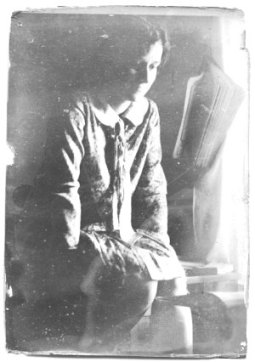
Young Winifred

Winifred Culliton Enright

My mother, Winifred Culliton Enright, was a painter. Her paintings hang on my walls. They have gone everywhere with me, to the South Seas and back. They have survived all the tropical cyclones I have. They are as part of my life as this tattoo, and like a tattoo I hardly see them anymore. They are her surrounding metaphor, she who is always with me but rarely in my thoughts.

Having an artist, an art teacher, for a mother took some of the mystery out of the profession. Her old studio—a room added onto a barn out back—was my play room when I became old enough to be trusted alone. In it were flat drawers and files of her art work from earlier years. I remember charcoal sketches of male art-school models, their jockstraps as well drawn as their muscle culture, always faceless or with their heads turned away.

The concept of careers wasn’t much pushed on kids of my generation. I don’t recall anyone ever asking me what I wanted to be when I grew up. But if they had, I would have blithely said a painter. I was already trying my hand. My earliest memories of drawing are of sailing ships. I could draw you the difference between a bark and a brigantine and name every sail and spar on a clipper ship. Mind you, in inner-city Buffalo I had never seen a sail boat, much less been on one. They were mythical vessels from pictures in books. Later, I read every sea-going saga in the Fairfield branch of the Buffalo Public Library. I was Midshipman Horatio Hornblower. I painted water colors of our frigate foolishly under mainsails in a heavy sea. I had never seen the sea.

Winifred had been trained at the Buffalo Fine Arts Academy, which was part of the city’s Albright Art Gallery. When I was sixteen I asked if I could take summer art classes at the now Albright-Knox Gallery. I had no idea what it cost—it never occurred to me—but she arranged it. I didn’t miss a class, even though I was playing baseball for several teams that summer. I would haul my catcher’s equipment bag with me to class with my uniform and all and then hide my art stuff in it from the guys I played with later in the day.

I don’t want to make too much of this, that my mother was an artist. By the time I knew her, she was mostly a mother. She’d had eight kids after marrying at thirty. I was the second to last. I remember once when I was a kid sneaking a look through vanity drawers and coming across her small box of jewelry, inside which was a fancy gold pin that said Art. At the time, I thought it referred to my dad, whose name was Art, and I thought that was neat, that she had a gold pin with his name on it. My oldest brother Joe became a painter for a while. I didn’t.

I never made it past semipro baseball either, though once I left home I have always needed to be near the sea. I was eighteen when I decided I would rather be a poet than a painter. Maybe I should have stuck with the brushes. For thirty years, Winifred was my most constant correspondent, and she carefully filed away every letter and postcard and poem and book of poetry I mailed her. And every time I brought a new wife to Buffalo to meet her, Win would treat them just like family. She was good at that. God bless her. She was good at a lot of things. She lived to be 94.

North Korean Soldiers

North Korean Soldiers

In the photo of the North Korean soldiers
can you zoom in on the woman marching
on the far left, the one with the fewest
medals on her chest and a mouth
like the petals of a baby flower,
the one holding her Kalashnikov
as if it were a Stradivarius?
God, she doesn’t want to be there.
Is that why she’s the prettiest?


Novel Talk

Fastnet

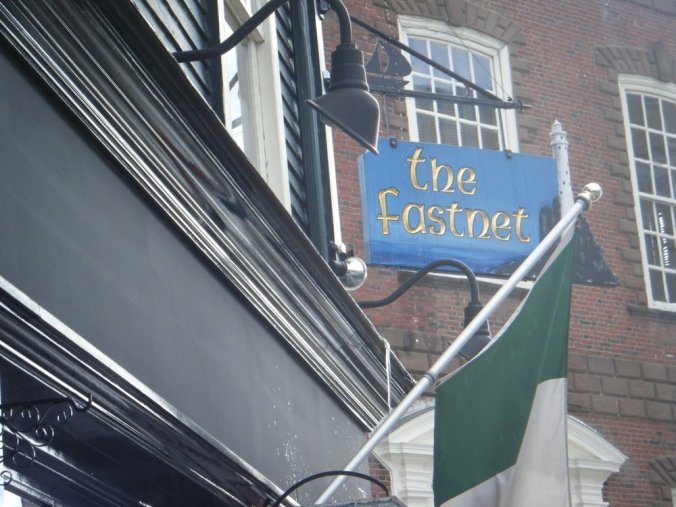
Saturday I gave a talk and reading at the Newport Public Library—a fine room, a lovely audience of sixteen. I sold two books, to old friends. (New Englanders are not into spontaneous purchases, a parsimonious crowd.) (Don’t forget that their Revolution was about not paying taxes.)  But listening to me was free. What I made on sales paid for drinks and a shared dish of fried calamari after at the Fastnet pub for Connie and me. I’m not complaining. Good squid, good Guinness, good company. A receptive audience at the reading as well. For those of you who missed the talk, here’s an excerpt, about writing novels.

I would like to read you some excerpts from the novels; but, given this opportunity, I would first like to throw in my tuppence about what makes novels work, whatever their pigeon-holed genre.

There is structure, of course. That’s a given. You’re telling a story, and in our Western tradition that means a beginning, a middle, and an end, however managed. That’s not a universal, by the way. It’s a requirement lacking in the folk tales of many cultures, and it is pretty much totally missing in the books of the Old Testament. But American readers are trained to have expectations they liked fulfilled. I think in three acts—set it up, fuck it up, resolve it.

For me, inside that structure there are three major areas of creative concern—character, place, and plot. In that order of importance. For me, novels are where I get to meet new and hopefully fascinating people—characters I want to hang out with or at least observe in true erratic human fashion, whose dialog both confirms and surprises. When I remember books, I remember characters.

Two, place. Real places, places closely observed and described. Places I can feel and see and smell. Nothing fantasy—no distant planets, please, no Narnias or Middle-earths or antiseptic Starships—but rooms I might sleep in, trails I would like to walk, real city streets that could not care less about me.

Plot is last, but you got to have one. By the way, plot is also not a universal in folk narratives, at least not plot as we think of it. I had a friend whose favorite put-down line was, “And your point is?” She watched a lot of television. Everything had to have a point, had to reach some previously hidden but predetermined dénouement. Every story was some sort of morality play.

The very popular success of the detective story has led to this. Those seemingly infinite hours of cop-show reruns on cable has pushed plot to the forefront—its twists and decoys, red mackerels and clever deductions. Plot has come to be synonymous with suspense, which is fine for a TV show that has to hold the viewer’s attention through multiple commercial breaks. (“Ask your doctor if this snake oil is right for you.”) But now that standard is being applied to novels as well, so that Grisham and King are the largest names on book covers—authors who admit the only way they can hold their readers’ attention is by scaring them or holding them hostage to the next secret. What was the name of that Dan Brown blockbuster, the one they made into a movie? I can never remember its name. The pacing of an international perils of Pauline. The language, the author’s voice has been drowned out by the suspenseful music on the soundtrack and the next staccato burst of automatic gunfire.

My Samoan mentor, the great playwright and screenwriter John Kneubuhl, who wrote episodes for many serial TV shows in the ‘50s and ‘60s, once pointed out to me that there are only four or five basic plots (which I have forgotten). “Boy meets girl; boy looses girl; boy gets girl back.” Think about it—are any of the novels in your personal pantheon there because of their plot? Reading a good novel should be more than finding out who done it. There is this garden of language and insight, character and place where a book can take you.

Plots are nice. Plots are necessary. So is popcorn at the movies, but you don’t judge the quality of your night at the flics by how fresh the popcorn was.


February

Crows 1 - Copy

Ask the crows

they have a quorum

in the barren trees.

They cast more shadows

than they number and

though they have no leader

they all follow.


All the other birds

excuse themselves

from the joyless woods.

A murder of crows

in a frozen world

knows how it feels

to be alone with death.


John Enright


The Gift Of Good Words

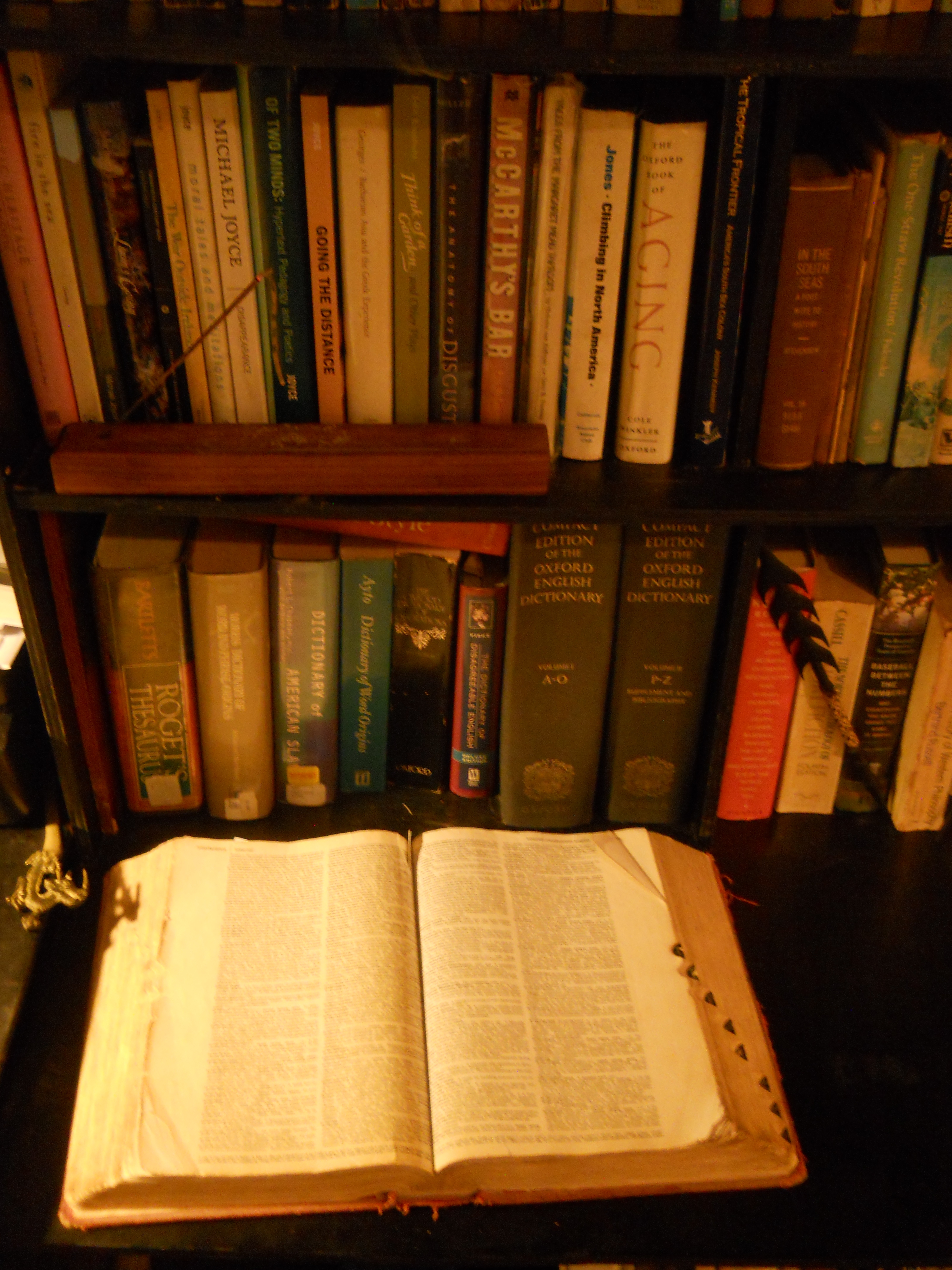
dictionary desk

Photo: Connie Payne

The other day, searching for something else, I came across the following essay I wrote for The Threepenny Review twenty-three years ago (Winter 1994 edition). The pages are now the yellow tint of an old man’s teeth, and they turn with an arthritic, archival resistance, sort of saying, Why are you bothering us? Leave us alone. This is the past.
But I thought I would retype and share it anyway, reprint it verbatim. It was written in Samoa, after a dozen years there, on one of my first word processors (as they were then called). I still have the same dictionary open beside me.

Reference Books                (© 1993 The Threepenny Review)

I was brushing out my American Heritage Dictionary of the English Language tonight (first edition, 1969). It was interesting to see which pages had the most dust balls and dead bugs in the cracks between them. It would seem from the evidence that I stall as a speller at predictable places.

Twenty-some years ago I was hired as a textbook editor at Prentice Hall, my first real editing job. In spite of my M.A., I just barely passed the spelling test. The guy that hired me made me promise that I would keep a dictionary open on my desk at all times. He would check. I did. He did. I left that job after a year or so, but I have had the same dictionary open on my desk ever since, flipped open to whatever page I last consulted.

I guess the books you refer to most often are called reference works. The books that are always in the same place when you reach out for them, ready to hand, discernable by touch. The books you take most for granted. The books no one else in the house or the office would dare remove. The books that have moved with you when most everything else was left behind.

This is nothing like having a spell checker on your hard disk. For instance, earlier this evening I looked up the word eavesdropper even though I was ninety-five percent sure of my spelling, because when I was writing the word out it had seemed so suggestive. A spell checker would have skipped right over it. I ended up reading the history of its Indo-European root “upo” in an appendix, which got me thinking about the Samoan word upu (which means “word”), then looking that up and following its varying meanings through different grammatical forms. Then the phone rang.

That’s part of the magic of reference works. My American Heritage can give me a one-sentence definition of Orpheus, but an even denser reference book, Robert Graves’s two-volume Greek Myths, can give me enough information to confuse me, make Orpheus lifelike, and send me off to the porch for a smoke and a stroll.

What else? The OED, Roget’s, Schultz’s Samoan Proverbial Expressions, the King James version of the Bible, Pound’s Personae, Milner’s Samoan Dictionary, Yeats, Buck’s Samoan Material Culture. Everyone has their own, highly personalized list. And the list changes with time as well. Since I have moved to Samoa, my Peterson’s Guide to Western Birds and Mencken’s The American Language have moved up a few shelves, out of immediate reach.

I once had a scheme—while still an undergrad in East Harlem—of translating The Dream Book into Spanish: an ultimate reference work for the neighborhood. Every morning when you passed the newsstand at the head of the subway stairs, one top issue of the Daily News would be turned over to the racing news page so that numbers players could check the final three digits of yesterday’s handle at the track to see if they held winning numbers. The guy who ran the newsstand did this as a public service, because otherwise every morning one third of the crowd going down the stairs to work would have been non-paying customers just thumbing through the top-of-the-pile Daily News looking for yesterday’s track attendance, ruining the merchandise.

The Dream Book was an ingenious product, but it was out only in English (and totally unprotected by copyright). What the thin Dream Book did was alphabetically translate your dreams into a three-digit number. Say you had dreamed of basketballs, you just looked it up under B and there in the parallel column was your number to bet for the day. No preface, no justifications, no footnotes, no author even, and no coins to toss or cards to relate to one another. Just look it up—as in a phonebook—and bet it. I dreamed of ducks in flight—374.

I could have sold 10,000 copies of a Spanish edition, very cheaply made. There was a need: so many ready Spanish-speaking reference-work customers out there. It never happened for some reason. I think I tried to ethnically edit it.

Have you ever ripped a page out of the phonebook in a public telephone booth just because you did not have either a pen or a spare piece of paper to write the number down on? And don’t you still feel a little bit antsy, too over-controlled, like some kid in study hall, when you are forced to consult some library’s sit-here-and-read-it reference work? Don’t you really want just to take it home for a day or two?

The other day I received an advertisement for the most-advanced-yet computer software package on the Bible: indices, commentaries, illustrations, a freshly translated “contemporary” text, a wholly new and user-friendly Old and New Testament. Now, nothing in the Bible was meant to make any kind of real sense—at best it is flashes of insight embedded in fields of blather—but it is fun to read now and then, and it is one of the core books most people in my cultural/historical lineage claim to defer to. A deference work more than a reference work, really—something to know about. I could not imagine a single reason why I would wish to supplant my ragged, taped together King James version with this Super Mario Brothers creation.

A tragic thing here in the equatorial zone: the books you touch the most die fastest. The oil in the sweat of your palms, tropic microbes, a Petri dish climate. Covers and bindings go organic; so that the books you consult the most become the most damaged, most bandaged. And the oldest die first, mimicking life.

Ezra Pound once wrote, “Culture is when you forget which book.” How many times must I check the spelling of paideuma before I arrive there?

—John Enright

Mike Maki Released From Prison

Mike Maki

Mike Maki saying goodbye to his garden at Sheridan Federal Prison Camp

A final dispatch from our POWOD correspondent at Sheridan Federal Prison Camp, Oregon. Mike Maki was released, after serving his three year term, earlier this month. Here is one of his final dispatches.

A Thousand Oregon Days and Nights 1/1/16

… And then some, since I came to reside here at the Sheridan Oregon Federal Prison Camp. Now I’m looking toward my last week here as a new year begins. Today, as we greet each other with “Happy New Year” it means different things to different men. Some of them have spent ten or fifteen New Years in prison, and because only nonviolent offenders qualify for camp, there is some resigned grumbling about spending such a chunk of their lives incarcerated.

For me, of course, it’s my third and last New Years here, and, I admit, I feel just a twinge guilty leaving everyone behind. Everybody’s glad for another’s imminent release, of course, but there are unspoken messages in the congratulations. But everyone, eventually, takes their turn through the exit turnstile.

There’s a broader shift in the population here this year, with many of the core inmate faculty in education also leaving. Besides the presidential clemency release of Chad Latham from the computer lab, Robert Miracle, the building trades lead is transferring to SeaTac FDC (Federal Detention Center) to finish his sentence nearer his family.

Then there’s Ned Roscoe, the super bright, but slightly crazy guy who spends his spare time (when he’s not teaching pest management or parenting classes) figuring out ways to provoke the people in blue, with the open sub-text of challenging them to do their jobs. Ned once ran for the governor of California as a Libertarian, and his right/libertarian perspective provides humor, challenge, and intellectual depth to all sorts of situations.

Other inmate teachers in GED and ESL have left recently, but as the saying goes, there’s another bus coming in right behind them. However, there is going to be a momentary gap, and I’m trying to help make a smooth transition in our voc-ed hort department. It’s going well, really, and the next crew is lining up. My last week will be filled with orientation as well as good-byes.

Even though SeaTac FDC is an indoor facility, with only one high window in the concrete rec area open to the sky as the only visual contact with the outside world, they have more liberal visiting regs and a couple of other percs, which include two-man rooms, which are much quieter (unless your bunkie happens to be a snorer) and more private (even though the in-room toilet calls for a bunkie etiquette of one guy leaving the room when the other needs to use the commode). Even though every family/friend visit to SeaTac involves a strip search for inmates, it’s one of those inconveniences that one simply gets used to. Here at Sheridan they just do random (and rare) strip searches after visits.

Apparently, the SeaTac FDC has set up a dedicated wing for campees who volunteered- or got drafted- to go there. Several guys have gotten shipped there over the last year, some willingly and some not. A few guys are like my bunkie Singh, who wants to transfer there because he can play cards, watch tv, or lay in bed all day, as well as see his family more frequently, basically wasting away his sentence in sloth and indolence. There are a couple of ways to do one’s time, and I haven’t felt like I had a day to waste anywhere along the way.

The truth is, I’m going to miss my friends here and can’t help but feel a tad guilty leaving them behind. After three years, I have become part of the old guard, and in my own way something of an inmate institution—the Plant Guy who can answer all your horticultural questions (fortunately, most all the questions are pretty simple ones), except for those pertaining to high-tech pot growing, for which there are some real wizards here. I’m also the resident old-school radical, not an angry one, but a peace and love stalwart who always has a note of good cheer (what I call “deep cheerfulness”) to accompany my freely offered opinions about the inequities and dysfunction of the System.

There’s also a big changing of the guard in blue suits, with a new warden coming on January 4, new counselors and case officers, and a whole raft of rookie men-in-blue corrections officers who’ve been showing up of late. It’s clear that our keepers, new and seasoned, are far from the best and brightest, but on the other hand they don’t for the most part either seem to be twisted and sadistic from their time spent on the job here in the human kennel. Messed-up alcoholics, maybe, and dog-kickers no doubt, mostly though, just BOP drudges doing their paid sentences to support their unhappy families.

All of this swirls together into the day-to-day life here that is a surreal reflection of the workaday world out there, except that here nothing much ever gets done, or done well. It is, as I’ve said before, the dysfunctional convergence of federal bureaucracy and trade unionism, long on gimme and short on giving a shit. I recall to my fellow inmates that while we come and go for a year or ten, our keepers are basically doing life sentences. It’s no wonder their life expectancies are short and suicide rate for their vocation (prison guards) is one of the highest in the country. We’ve had one c.o. suicide during my time here.

To create and maintain something resembling a real esprit de corps is a tall order, and it begins with the quality of people who choose the field as a career. There seem to be endless days in training for the c.o.’s, although to what end is opaque from here.
Altogether a tough business, and I’m curious to observe who shows up in both color uniforms. One thing for sure is that the potential for human development for the inmate is huge and virtually untapped. Rehabilitation receives lip service, but is basically a joke. There’s just not enough intelligence and initiative on the “management” side, or support for it from on high, where the mindset of punishment versus rehabilitation has not yet been resolved.

May the new year bring a new breath of change for the BOP, for the benefit of all involved—inmates, cops, and all of their families on either side of the legal divide, which divide is thinner all the time with the ongoing decline of the West.
I look forward to beginning the process in person in 11 days of reunion with my many friends. All my relations! -MM

Blog Off

Red maple - wind chimeEverything in nature is lyrical in its ideal essence,
tragic in its fate, and comic in its existence.
 –George Santayana

Every so often the old Monsignor at our family parish would deliver a Sunday sermon castigating parishioners for skipping their Sunday obligations. My mother always found these performances funny. “Wagging his finger at empty pews, scolding the dutiful.”

I feel a kinship with the old Monsignor tonight. As blog readership has sloughed off, down to just the hyper-faithful, I wonder if Reality Salad has run its course. It’s been ten months now, fifty postings. Time to give it a rest, with a bow and a blown kiss to those of you who still check in. We won’t take the site down, just let it hibernate. I have Dominick novels to write.

Back in the day (that would be the ‘70s), when I was on the road a lot, I rolled my own cigarettes. Top tobacco (“STAY ON TOP”) came in a yellow paper packet with glued rolling papers. For a quarter I could roll thirty real smokes. The inner pouch was made of foil-backed white paper, which, when emptied, could be flattened out into a sturdy five-by-seven-inch piece of stationary—perfect for notes and poems with short lines. On the road that’s what I wrote on. Folded back up, foil-side out, they were impervious to the travails of backpack life. The size of the page dictated the content. My sprung sonnets matured there, constrained by the size of that foil-backed piece of paper. They collected themselves in a side pocket of my REI backpack—my blog site forty years ago.

That was a much more private time. People took pride in their secrets. Whatever was deemed worth sharing was shared with just a few intimates, and in person. Every so often back then I would go through the poems in the backpack and pick ones to type out and Xerox and staple together into a chapbook and mail out to 20 or 30 friends. Xerozines, poems for free. Rarely did people acknowledge receiving them; that was unnecessary.

So we will set the Reality Salad bowl adrift for a bit, see where happenstance floats it. Adieu, my friends.

John Enright